


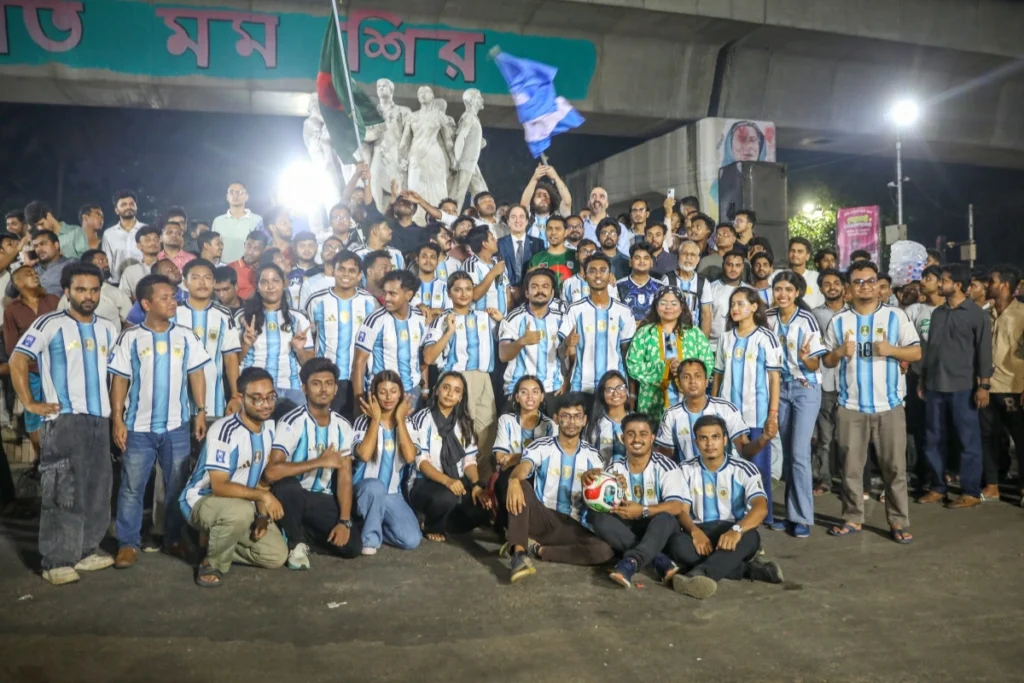
LONDON — Packed fan zones in Dhaka erupted when Lionel Messi scored Argentina’s opening goal at the 2026 FIFA World Cup, despite there not being a single Argentine supporter among the thousands celebrating.
The scenes highlighted a striking reality of global football: some of the world’s most passionate football nations remain absent from the game’s biggest stage.
According to BBC report, among the world’s 10 most populous countries, only the United States and Brazil qualified for the 2026 World Cup. India, Bangladesh, Pakistan and Ethiopia have never appeared at the tournament, while China has qualified only once, in 2002, and Indonesia’s only appearance came in 1938 under the name Dutch East Indies.
Experts say population alone is far from enough to build a successful football nation.
British economist Stefan Szymanski, co-author of the best-selling book Soccernomics, argues that sustained football success depends on three key ingredients: population, wealth and footballing tradition.
“Football is very similar to how national economies work,” Szymanski said. “For them to thrive, you need people. But then you also need capital and infrastructure.”
He noted that successful football nations also benefit from decades of accumulated experience and strong domestic development systems.
“The nations that have ever won the World Cup are the ones that were dominant in playing the game 100 years ago,” he said.
That historical advantage continues to shape international football today.
Seven of the eight countries to have won the World Cup — Argentina, Brazil, England, France, Germany, Italy and Spain — have relatively large populations and long-established football cultures. Uruguay, with just 3.5 million people, remains the only exception after winning the tournament in 1930 and 1950.
While emerging football nations have made significant progress, few have consistently challenged the traditional powers.
Morocco has become the continent’s standard-bearer after reaching the semifinals in 2022 and the quarterfinals again at the 2026 World Cup. South Korea remains the only Asian nation to have reached the World Cup semifinals.
Other populous nations continue to face structural challenges.
Ethiopia, which came closest to qualifying for the 2014 World Cup, has struggled with underinvestment and a shortage of suitable stadiums, forcing its national team to play home qualifiers abroad.
In South Asia, many point to cricket’s popularity as an obstacle, although critics argue governance and infrastructure remain the bigger issues.
“The popularity of cricket is purely an excuse,” Bangladeshi writer and actor Audite Karim said. “We simply do not have the preparation and structural framework required for a country to play in the World Cup.”
China presents another unique case. Despite major investment in football over the past decade, including attracting international stars to its domestic league, the country has failed to return to the World Cup since 2002.
Indonesia has shown encouraging progress after reaching the final round of Asian qualifying, although much of its recent improvement has been driven by recruiting players of Indonesian heritage born in Europe.
For millions of supporters across Asia and Africa, however, the World Cup remains as much about participation as qualification.
“In light of reality, I do not see any possibility of seeing Bangladesh play a World Cup in my lifetime,” Karim said. “But Bangladeshi football fans will still want to experience every bit of the joy of the tournament.”
Source: Saudi Gazette