


SEOUL — South Korean authorities are deploying drones to issue heat warnings to farmers while residents are taking shelter in airports, as the country battles an unprecedented heatwave.
President Lee Jae Myung has ordered public agencies to mobilize all available resources to deal with the extreme heat, which he has called a “national disaster”.
“Extreme heat on a scale we have never experienced is continuing day after day. Heatwave conditions once seen only in foreign news reports have now become our reality,” President Lee Jae Myung told a heatwave response meeting on Thursday.
Lee ordered ministries and local governments to mobilise all available personnel and resources until the heatwave eases, stressing protection of lives and safety, stronger safeguards for vulnerable residents and stricter enforcement of rest breaks for outdoor workers during the hottest hours.
The warning came as Seoul endured another stifling night before what forecasters say could be one of the hottest days in the city’s modern history.
Temperatures in the south soared to a record 42.5C (108.5F) earlier this week.
Temperatures in some neighbourhoods barely slipped below 30 C overnight, according to the Korea Meteorological Administration (KMA), while media showed crowds seeking refuge in streams, department stores and other air-conditioned spaces.
Most outdoor activities have been canceled on the advice of the national weather agency. These include the daily changing-of-the-guard ceremony at Seoul’s Gyeongbokgung Palace.
The Korea Baseball Organization canceled all 10 games scheduled for Wednesday and Thursday after some spectators fainted in the heat, media reported, including one fan who collapsed during a game in Incheon.
Meteorologists say Typhoon Dolphin, despite posing no direct threat to South Korea, may be contributing to the scorching conditions.
At least 23 people have died from heat-related illnesses in the country so far this year, while nearly 2,500 have visited emergency rooms for heat-related conditions since mid-May, authorities say.
“Heatwave conditions once seen only in foreign news reports have now become our reality,” Lee said on Thursday.
Some local governments have deployed trucks to parks, markets and bus stops to distribute chilled bottled waters for free.
In the southern city of Yangsan, where the mercury hit a historic high of 42.5C on Sunday, fleets of sprinkler trucks have been roaming the streets, spraying water onto sun-baked roads.
Meanwhile in rural areas such as North Gyeongsang province, local authorities are deploying drones attached with loudspeakers and thermal imaging cameras to protect its farmers, many of whom are also elderly.
The drones hover over the farmers, broadcasting warnings such as “it’s hot, you need to go inside” to remind them to take breaks and cool down.
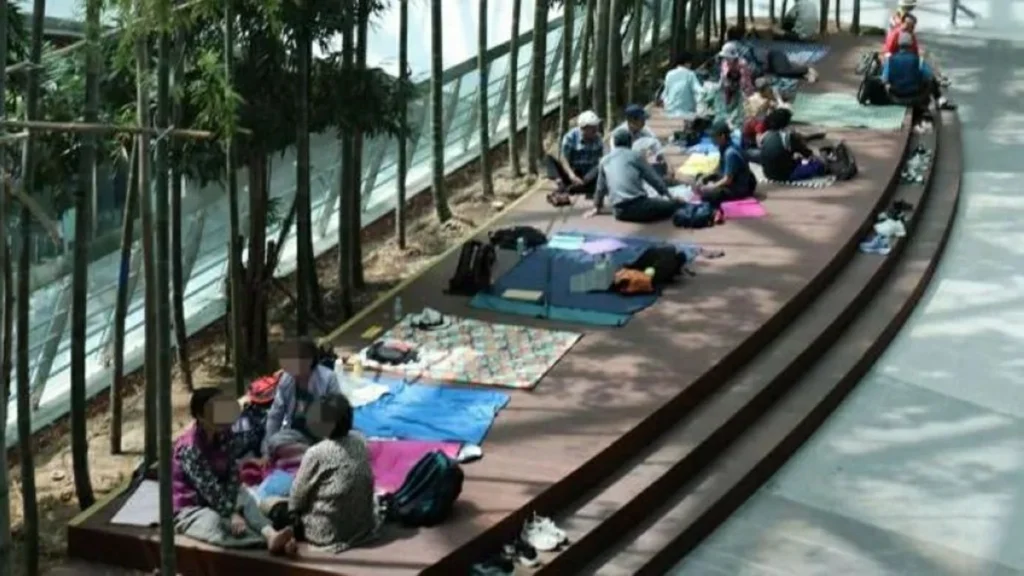
Amid the scorching temperatures, South Korea’s air-conditioned airports – including its largest in Incheon – have become a refuge for some vulnerable communities, including the homeless and the elderly.
Photographs on local media show people lying on benches and platforms, using towels as makeshift blankets.
One visitor sheltering in Seoul’s Gimpo airport told The Korea Times it is a “perfect place to rest without spending any money”.
“I come here from time to time with my friends whenever the weather gets too hot,” he said.
Meanwhile a mobile app developed by an undergraduate to direct people to the shadiest walking paths has gained traction online, particularly among students.
Geuneulro, named after the Korean term for “shaded road”, takes into account the positions of the sun and shadows cast by buildings and trees to recommend the most shaded routes through the city.
“This summer has become so hot that I feel like meat on the grill,” the app’s developer Yu Min-jun told BBC Korean.
Yu says he came up with the app after struggling with commuting in the heat.
Climate experts have said the extreme heat could ease starting this weekend, with daytime highs falling to around 36C, but the hot weather could continue.
Earlier this week, Seoul’s meteorological administration forecast a 50% probability that temperatures in September and October could continue trending higher than average.
Source: Saudi Gazette