


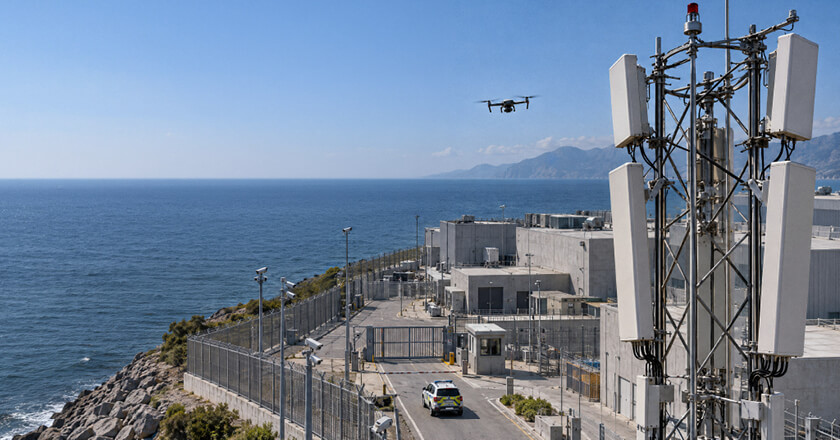
Existing mobile networks can help close a gap in detecting low-flying, fast-moving objects such as drones across wide areas. Following successful testing of Integrated Sensing and Communication (ISAC) technology over the past months, Ericsson recently introduced the Ericsson ISAC System.
The new solution adds sensing capabilities to the mobile network, enabling defence, public safety and critical infrastructure operators to detect and track moving objects, even when they are not connected to the network.
Commercial introduction of the Ericsson ISAC System will take place in phases, beginning with small-scale, sensing-only commercial pilots with selected customers in 2027, followed by broader-scale deployments from 2028. The integrated communications capability will be added as the solution evolves towards 6G.
Small, low-cost drones are increasingly being used for unlawful surveillance, organised crime, sabotage, and warfare. Their size and flight behaviour at low altitudes make them difficult to detect, which creates new challenges for national security, critical infrastructure protection, and public safety. Dedicated sensors will remain important for protecting critical sites but scaling them across larger areas may be challenging due to the significant new infrastructure required.
The Ericsson ISAC System closes the low-altitude, wide-area detection gap by transforming the mobile network into a new layer of situational awareness. Using sensing-capable 5G radios, edge computing, AI and signal processing, it detects objects that are not connected to the network and maintains tracks across the coverage area, complementing radar and other sensors rather than replacing them.
How it works
Ericsson ISAC System detects and tracks objects by analysing how radio signals are reflected by objects in the environment. It operates as a multi-static system, which means that sensing signal transmission and reception are distributed across multiple geographically separate mobile-network sites. This allows objects to be viewed from multiple angles at once – providing high accuracy that increases detection confidence, positioning, track continuity, and coverage resilience.
The Ericsson ISAC System uses parts of the 5G mobile network infrastructure – such as towers, backhaul and spectrum – already in place across cities, transport corridors and strategic locations to provide tracking data and AI-based classification. This data can be securely shared through standardised interfaces with authorised external systems, including security and command and control systems. Combined with data from other sensors and mitigation platforms, it can give users a more complete operational picture, helping them respond faster and make more informed decisions.
In validated tests, the system reliably detected and tracked micro drones at kilometre-scale distances with precise 3D positioning. Testing demonstrated consistent detection and tracking across a range of operating conditions, system configurations and drone flight patterns. Actual performance depends on factors such as the characteristics and flight profile of the target, sensing geometry, terrain and surrounding environment, and system configuration.
Evaluated in live 5G demonstrations
Trials with AT&T in Arlington, Texas, used sensing dashboards to display drone activity. Combining Ericsson technology with AT&T’s network expertise, the trial detected, located multiple drones, and tracked their movements, illustrating how wireless infrastructure could help protect major venues, critical infrastructure and other key locations.
A separate demonstration with Erillisverkot in Helsinki showed multiple 5G sites detecting and tracking drones, demonstrating how network sensing can support public safety and counter-UAS (Unmanned Aircraft System) operations while extending coverage alongside traditional sensors.
In Poland, Ericsson, Asseco and Play demonstrated how Ericsson’s Integrated Sensing and Communication technology, Play’s mobile network and Asseco’s PUSZCZYK acoustic detection system could support detection and positioning of low-flying drones with higher accuracy.
Potential applications
Defence and public safety: Enhancing airspace monitoring across borders, coastlines and strategic assets.
Critical infrastructure: Strengthening protection for ports, power plants and other vital sites.
Transport and industry: Supporting safer operations across road, rail and industrial environments.
Low-altitude economy: Drone traffic management, urban airspace monitoring, and digital twins for smart-city planning and environmental mapping.
Freddie Södergren, Global Head of Mission Critical Networks and Defence, Ericsson, says: “Low-flying drones create a detection coverage gap that no single sensor can effectively address. Ericsson ISAC System enables multiple 5G sites to deliver coordinated wide-area detection and continuous tracking, with data that can be integrated with traditional sensing technologies and operational systems. It also gives operators a pathway to create new services from existing network assets”.
Joe Madden, Principal Analyst at Mobile Experts, says: “Ericsson’s ISAC System shows that mobile-network sensing can perform far better than many expect, turning complex radio reflections into remarkably accurate tracking of low-flying, uncooperative objects. By building on an extensive footprint of existing sites, Ericsson has the potential to deliver wide-area drone detection faster and more cost-efficiently than deploying new dedicated sensor infrastructure”.
Discover how Ericsson ISAC System closes the low-altitude detection gap
Image Credit: Ericsson
Source: Tahawul Tech