


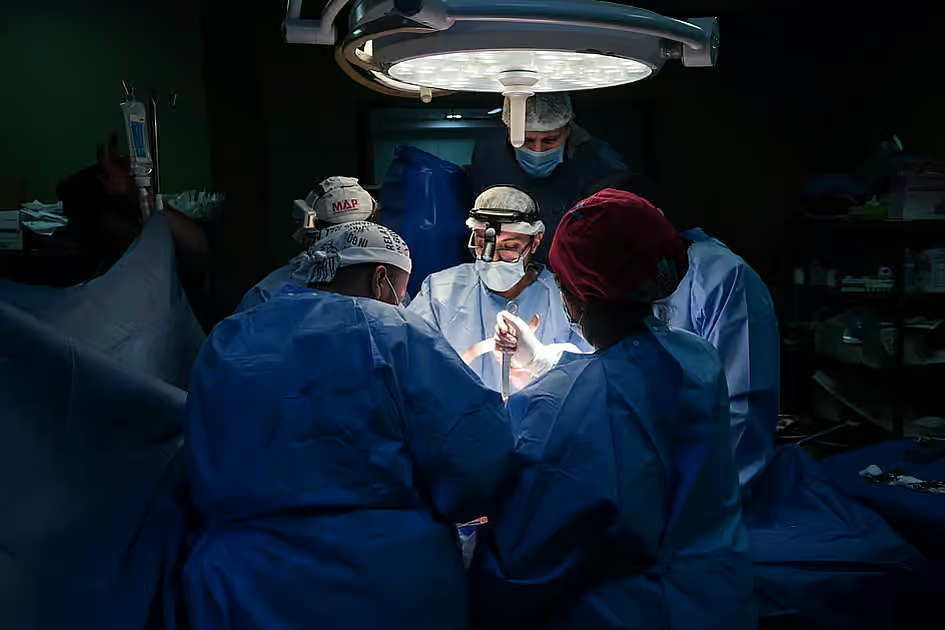
More than half of all organs transplanted in the UAE have been kidneys and doctors said that there are two big reasons behind the number. Of the 1,780 organs transplanted in the UAE, 924 were kidneys, making them by far the most commonly transplanted organ.
Doctors said that this is partly because kidney failure is much more common than failure of several other major organs, and partly because a healthy person can donate one kidney while still alive.
“Unlike most major organs, a kidney can be donated by a healthy person while alive because we can live normally with one functioning kidney,” said Dr Ghulam Farid Rana, consultant nephrology and transplant physician at NMC Royal Hospital Sharjah.
Stay up to date with the latest news. Follow KT on WhatsApp Channels.
“This makes living-donor transplantation possible and gives patients an additional source of organs beyond deceased donation.”
Why are so many kidneys failing?
Doctors said that diabetes, high blood pressure and obesity are among the biggest reasons patients develop chronic kidney disease. Dr John Cherian, specialist nephrologist at Aster Hospital, Mankhool, said that chronic kidney disease affects around 10 per cent of the general population globally.
He said that diabetes, hypertension and obesity alone account for a large share of chronic kidney disease cases. “Type 2 diabetes mellitus still retains the top position among the causes. Hypertension comes next,” he said.
Other causes include conditions such as glomerulonephritis, polycystic kidney disease and chronic kidney infections.
Dr Umar Maqbool, specialist general surgery, transplant services at Burjeel Medical City, said that diabetes and hypertension remain the most common causes of chronic kidney disease in the UAE as well. “Obesity is also an important risk factor. The problem is that kidney disease can develop quietly.”
“The kidneys function in silence,” said Dr Cherian.
A person can lose a significant amount of kidney function before noticing obvious symptoms, meaning some patients are diagnosed only after the disease has already reached an advanced stage.
Living donors make a major difference
Kidney transplantation is also different from heart, lung or liver transplantation because a living person can donate one of their kidneys.
Dr Rana said that this is one of the biggest reasons kidney transplantation can be carried out on a larger scale. A healthy donor can usually continue living a normal life with the remaining kidney after undergoing detailed medical and psychological assessment.
Living donation also means some patients do not have to wait entirely for an organ from a deceased donor. “The transplant can often be planned rather than waiting for an appropriate deceased-donor kidney to become available,” said Dr Rana.
In selected cases, he said that patients may even receive a transplant before spending a long period on dialysis. “Donation must always be voluntary and that the donor’s health and safety come first,” he added.
Doctors assess kidney function, blood pressure, blood sugar, heart health and overall medical history before approving a donor. Blood tests and scans are also carried out to check compatibility and whether the kidney can be removed safely.
Why transplant instead of dialysis?
For patients whose kidneys have stopped working properly, dialysis can replace some kidney functions by removing waste and excess fluid from the blood.
But treatment usually needs to be repeated regularly and can affect work, travel, diet and family life. “A functioning transplanted kidney works continuously inside the body and can provide greater freedom and independence,” said Dr Rana.
For suitable patients, he said that transplantation is generally associated with better long-term survival and quality of life compared with remaining on dialysis. However, a transplant does not mean treatment ends.
Recipients usually need anti-rejection medicines for life, along with regular blood tests and follow-up appointments.
Demand remains high
Despite kidney transplants making up the largest share of organ transplantation in the UAE, doctors said that the need for organs remains significant.
More than 4,000 people in the UAE are reported to be suffering from chronic kidney failure, according to figures cited by doctors.
Dr Maqbool said: “Patients with stage 5 chronic kidney disease or end-stage renal disease can require transplantation, but how quickly they receive a kidney depends largely on donor availability.”
Doctors said that expanding both living and deceased donation, increasing awareness and using options such as paired kidney exchange can help increase the donor pool.
For residents the first step comes much earlier. Dr Cherian said: “Kidney disease can be detected using two relatively simple tests. GFR, which measures kidney function, and urine ACR, which checks for protein leaking into the urine.”
With diabetes, high blood pressure and obesity increasingly putting kidneys at risk, doctors said that early screening could help prevent some patients from ever reaching the point where a transplant becomes necessary.
Source: Khaleej Times