


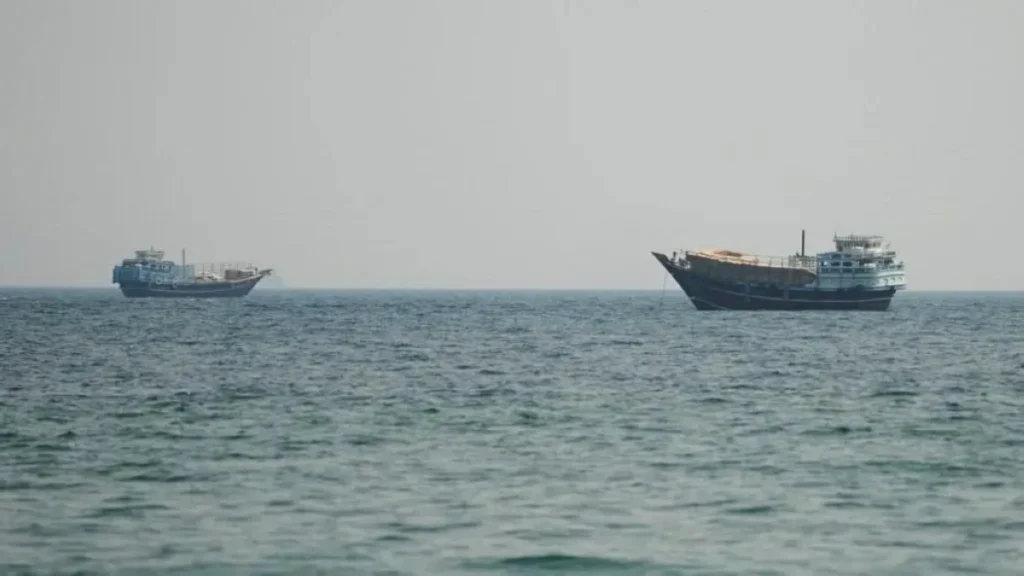
DUBAI — The United States and Iran launched attacks on each other’s interests in the Arabian Gulf on the fourth consecutive night as Washington reimposed its naval blockade of Iranian ports.
Attacks have also been reported in Kuwait, Bahrain and Jordan as Tehran said it was targeting US assets in the region.
The US military early Wednesday resumed a blockade on Iranian ports over Tehran’s attacks on ships trying to pass through the Strait of Hormuz, the US military’s Central Command said on Wednesday.
The US first imposed the blockade in mid-April and then lifted it in mid-June, a day after signing the interim deal that set a 60-day period for negotiations over issues like Iran’s nuclear program, but talks have stalled as fighting over the strait has intensified.
Trump said a negotiated deal was still possible even as fighting surged to a scale unseen since the April ceasefire.
Meawhile, Trump on Tuesday backed down on his threat to heavily tax ships passing through the Strait of Hormuz.
As attacks in the waterway continued, Trump said he was scrapping a planned levy on ships passing through it that he announced a day earlier, replacing the fee with trade deals with Gulf allies.
Iran’s top diplomat Abbas Araghchi had mocked Trump’s threat before attacks between the decades-old foes continued.
In a post on ‘X’. Araghchi took a swipe at Trump, asserting that Iran will always remain the “guardian” of the Strait of Hormuz.
Trump’s plan to charge fees would have been a change to longstanding American policy and a departure from US promises that the strait would remain open to all without tolls.
Trump had claimed that a 20 percent levy on transiting cargo was a necessary measure to cover the operational expenses of securing the volatile shipping lane.
Washington has vehemently opposed Tehran’s desire to charge tolls in the strait, which international law generally forbids.
Oil prices had jumped more than 5 percent after the latest strikes, but later pared gains as Trump backpedalled on his proposed levy.
The price for a barrel of Brent crude oil, the international standard, briefly topped $87 early Tuesday, still well below the nearly $120 reached at the height of the war. The price dipped to $78 in the aftermath of Trump’s announcement that he had changed course.
Iran reported fresh strikes late Tuesday on its Gulf island of Qeshm in the Strait of Hormuz, the key shipping channel for Gulf oil and gas that has been largely blocked by Tehran since the start of the war.
It came after the US military said it hit targets across Iran including in the port cities of Bushehr and Bandar Abbas to “degrade Iran’s ability to attack commercial shipping”.
Local authorities said the US struck “four points” in Bushehr,which hosts Iran’s only civilian nuclear power plant, as well as an Iranian border area near Iraq and Kuwait.
Iran in turn hit ships in Omani watersthe Strait of Hormuz.
A Norwegian tanker was hit by an explosion caused by an unidentified device off the Omani coast early Tuesday, the crisis response company MTI Network said.
Since last week, renewed US attacks have killed at least 28 people in Iran, according to an AFP tally based on Iranian media and official announcements.
After the strikes, Iran’s Revolutionary Guards announced they had in turn fired missiles and drones on Bahrain, targeting a residential building for US forces and other facilities.
Bahrain said it had intercepted “several treacherous aerial attacks launched by Iran” and accused Tehran of targeting civilians, after explosions and sirens were heard in Manama several times.
Kuwait separately said an Iranian attack wounded four members of its navy Tuesday and set a building on fire.
Tehran launched attacks on other US allies in the region, including Jordan, which said it had shot down four missiles from Iran.
Iran’s Revolutionary Guards said their strikes targeted US forces at an air base and urged Jordanians to issue a “serious demand for the removal of the occupying American bases from the region”.
The attacks again raised the possibility that Gulf Arab states were retaliating against Iran without discussing it in public.
Iran insists it only targets US interests in the Gulf, but its military command spokesman said any collaboration by Gulf countries with the United States would be considered “an act of war”.
Trump also threatened to destroy Pickaxe Mountain, a deeply buried nuclear site near Natanz where Western intelligence suspects Iran is building an undeclared enrichment facility.
“Tell the Iranians to be ready. Let them know we’re coming (and) there’s not a damn thing they can do about it,” he told conservative radio host Hugh Hewitt.
Regional mediators meanwhile are still trying to get the United States and Iran back to the negotiating table, according to two regional officials.
The officials, speaking on condition of anonymity to discuss the delicate diplomatic process, said Pakistan-led mediation was working around the clock to reactivate the ceasefire.
Israeli Prime Minister Benjamin Netanyahu, a fierce opponent of Iran’s alleged nuclear ambitions, warned Iranian leaders Tuesday that Israel would deal a heavy blow if they launched an attack on his country.
Speaking from Dimona, a southern town widely believed to house Israel’s undeclared nuclear arsenal, he told them: “Do not count on things remaining quiet if you attack us.”
“The days are over when someone strikes us and we don’t hit back with a decisive blow.”
Source: Saudi Gazette