


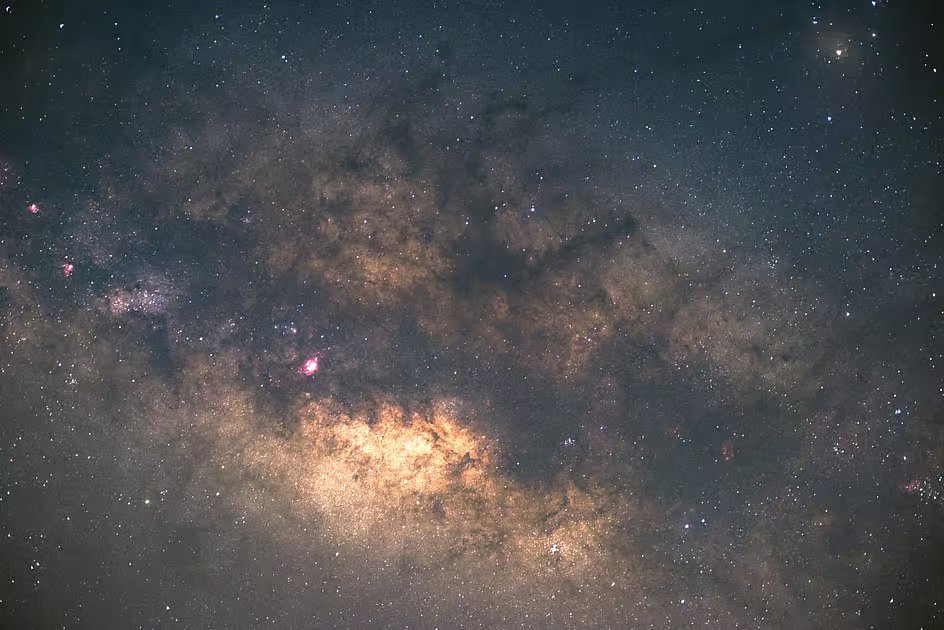
It’s Milky Way season in UAE, and people are flocking to what is termed as “one of the darkest spots in the country” — Abu Dhabi’s Al Quaa desert.
Hundreds of residents turned up in late May as Dubai Astronomy Group organised an event. But can you drive there yourself? Yes, according to Khadijah Al Hariri, Operations Manager, from DAG. Here’s what you need to know.
Stay up to date with the latest news. Follow KT on WhatsApp Channels.
What is the Milky Way spot, and when is the best time to go?
As the name suggests, the Milky Way spot in Abu Dhabi’s Al Quaa offers you unparalleled views of our galaxy. The “season” starts from late March, and it remains visible till September, Khadijah said.
The best time for observers to view the Milky Way is after 9pm, up until 3am, as these hours offer visibility of the core. “While the exact centre of the galaxy is not visible, observers can see the bright Milky Way core region around it,” she added.
To spot the Milky Way, use apps like Stellarium to help you first find constellations. Look south to southeast, and find the Scorpius and Sagittarius constellations. Sagittarius is shaped like a teapot, Khadijah said.
Once the constellations are located, the faint cloudy band rising from that area is the Milky Way. It becomes clearer, and higher in the sky as the night goes on, she added.
How to reach the location?
The trip takes around two to three hours from Dubai and Sharjah. It is best to leave around 7pm to reach before darkness sets in. Make sure to fuel up before you leave.
There are multiple routes to reach the spot, including using the highways like E611 (Emirates Road), E11 (Sheikh Zayed Road), and E66 (Dubai-Al Ain Road). Then, you will have to take the exit towards the Al Ain direction, after which there several truck roads you will follow.
Since the desert can be reached through multiple routes, and requires you to take different exits on various roundabouts, the best thing to do is download offline maps to the ‘Al Quaa Milky Way Spot.’
Downloading the offline map is particularly important as you may find that your mobile signal does not work in the desert.
A few kilometres before the spot, you will see a gate, which opens on its own. Do not be in a rush, drive slowly and carefully through the gate. Once you have crossed it, any location works as long as you are not too close to city lights. Do not venture too deep in to the desert, Khadijah stressed.
While any car can make it through, and you do not necessarily need a 4×4, it is important to stay away from the edges of the road. Stay in the centre, and drive in a straight line on the paved part, so you don’t get stuck in loose sand.
What you need to know
-
There are no facilities close by to the desert. The nearest restroom is 45 minutes away, at the Adnoc petrol station, where you can also get snacks and drinks. Keep this in mind when planning your trip.
-
Wildlife such as camels, spiders, and scorpions may be present. Wear closed shoes, and avoid wandering deep into the desert. It is preferable to go with large groups of people, and stay together.
-
Bring essentials like water, snacks, a jacket, and a chair or mat. If you are camping there, avoid open food and barbeques. Avoid bonfires directly on sand, use portable bonfire pits instead.
-
Plan your visit around the new moon to avoid moonlight affecting visibility. You may also check a light pollution map.
-
Once on site, use red light only. Dim your car lights, and avoid flash. Keep noise to a minimum and be respectful of others’ setups. Clean up after yourself and take all trash with you.
Is it all worth it?
While it can be a bit of a hassle to drive down, “the payoff is beautiful. The purpose of viewing the Milky Way makes the visit very meaningful,” says long-time UAE resident Karren, who hails from India.
Karren, along with her husband Rony, said they are enthusiasts of “creation”, including the astro world. However, this is the first time Karren has been to a space event despite living in UAE for almost 30 years, she said.
“As we entered Al Quaa, we realised we are cut off from the light and it was very different from city skies,” Karren said.
“With the size of one star being many times bigger than our planet, we are in awe at seeing so many stars in this small area in the sky,” Rony added.
On the other side of the event, is Raghav Krishna, a 16-year-old volunteer at DAG, who has participated in multiple space events. The young space enthusiast said he never tires of sharing “cool” space facts with others, and that “knowledge is only useful when you share it.”
Milky Way is also a celestial body which never gets old no matter how many times one observes it, he added. To volunteer at these events, he also balances academics with his passion. While applying for competitive exams, the cosmos serves as a nice break from his studies, he added.
Raghav also explained that UAE deserts are a scientifically, and geographically apt place to observe the universe due to their good climate, dark nights, lack of light pollution, and lack of moisture.
Source: Khaleej Times