


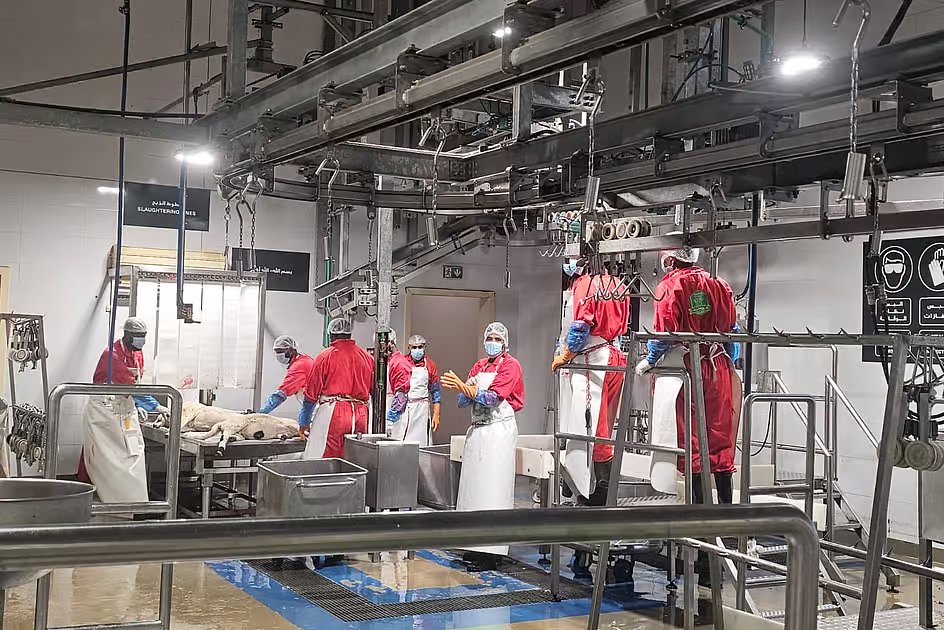
Thousands of residents wait outside UAE abattoirs during Eid Al Adha to collect meat from their sacrificial animals. But few see the organised, fast-moving and carefully monitored process that takes place behind doors, from slaughtering and veterinary inspections to cutting, packing and handing over the meat.
Khaleej Times took a tour inside the Sharjah livestock market abattoir in Sajaa to understand what happens inside one of the busiest facilities during Eid Al Adha, and spoke to workers handling different stages of the process.
Inside the facility, goats fitted with identification tags move through narrow barriers before reaching the slaughtering stations. Workers wearing gloves, masks and aprons stand across different sections as animals move from one stage to another in a coordinated flow.
Stay up to date with the latest news. Follow KT on WhatsApp Channels.
A worker handling the slaughtering process said every animal is first identified before the sacrifice is carried out. “We confirm the details and read the dua (prayer) in the name of the person offering the sacrifice before the process begins,” he said.
According to workers, slaughtering usually takes around two minutes. The animal is then moved to another section for deskinning, which takes around five to seven minutes.
A worker in the abattoir said several teams work simultaneously during Eid to manage the heavy rush. “There are multiple stations operating at the same time. During Eid, additional staff are deployed to speed up the process,” he said.
After skin removal, the meat goes through inspection and cleaning before reaching the cutting section, which workers said is the most time-consuming part of the process.
“The cutting depends on what the customer wants,” explained another staff member. “Some people ask for the animal to be cut into four large pieces, some want small pieces, while others request the whole animal.”
Workers said cutting alone can take around 10 minutes, while packing and handing over the meat usually takes another two to four minutes. Under normal circumstances, the entire process from slaughtering to handing over the meat takes around 20 minutes. “The procedure takes about 20 minutes, but during the Eid days because of the rush, waiting time may vary,” said the worker.
Tagging system at abattoirs
One of the biggest concerns residents have every Eid is whether meat from different animals gets mixed during the rush. Workers at the abattoir said a tagging system is used throughout the process to avoid confusion. “The animal is tagged before slaughtering, and the same identification stays with the meat until packing and handover,” a worker explained. “Usually, one or two people handle the cutting of one animal, and the tag remains attached to the packet before it reaches the customer.”
Veterinary doctors are also present inside the facility to inspect both the live animal and the meat after slaughter.
A veterinary doctor at the market explained that the checks are carried out to ensure the meat is safe for human consumption. “We inspect the animal before slaughtering and also check the organs after slaughter, including the liver, lungs, heart, kidneys and intestines,” the doctor said.
Doctors also check for signs of disease, infections, unusual smell or discolouration in the meat. They monitor hygiene conditions inside the facility and ensure the meat is not contaminated during processing. “If we find serious disease or contamination, the affected meat or sometimes the entire carcass is rejected and safely disposed of,” the doctor added.
Residents can watch different stages of the process, including skin removal, inspection and meat cutting of their sacrificial animals, through transparent glass barriers inside the abattoir.
Workers said waste from the facility is collected separately through a dedicated outlet before being loaded onto trucks for disposal.
Qasim, a trader working at the Sharjah livestock market, said many residents are often surprised to see how systematic the process is inside the abattoir. “People usually worry about waiting time or whether the meat gets mixed, but there is a proper system here for everything,” he said.
Operations at the Sharjah abattoir begin at 6am during Eid and continue until 10pm, with additional workers deployed across slaughtering, cleaning and packing sections to manage the festive rush.
Source: Khaleej Times