


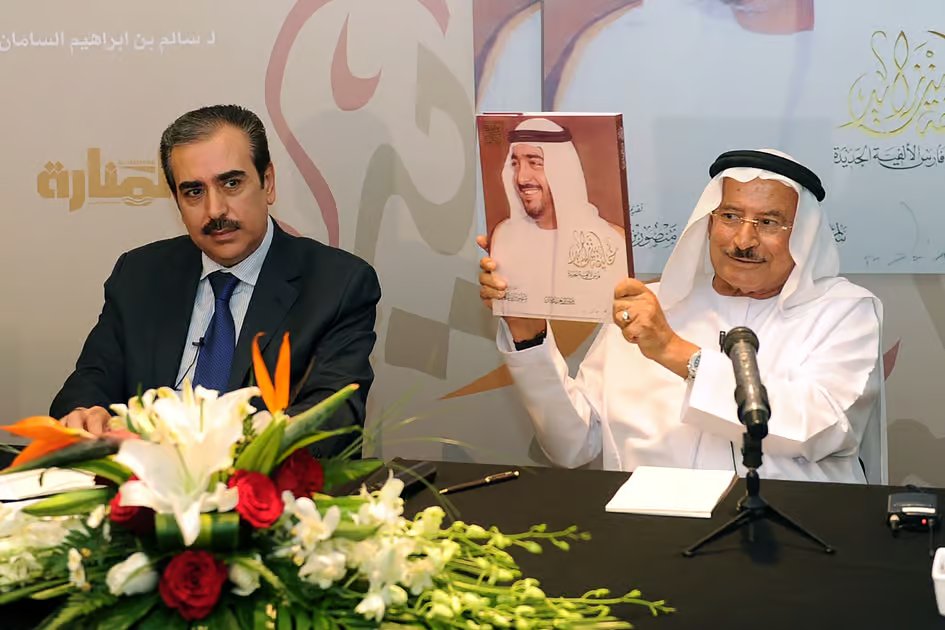
When Salem Ibrahim Al Saman arrived in Abu Dhabi in 1961, the emirate had no paved roads, no electricity, and limited organised trade. He came from Ras Al Khaimah, where he was born in 1938, and had already worked in maritime trade from a young age alongside his father. His move to Abu Dhabi placed him in a city that was still forming its administrative and economic structure.
Al Saman died on Saturday. UAE President Sheikh Mohamed bin Zayed Al Nahyan paid tribute, noting his contribution to the country’s economic development and his association with the late Sheikh Zayed bin Sultan Al Nahyan.
Upon arrival, Al Saman met Sheikh Shakhbout bin Sultan Al Nahyan, the then ruler of Abu Dhabi. In the years that followed, he worked in proximity to Sheikh Zayed during his rule in a time when Abu Dhabi was undergoing its own changes economically and politically.
Stay up to date with the latest news. Follow KT on WhatsApp Channels
According to Arabic accounts, his responsibilities during that time included logistical and operational support around leadership activities, from coordinating hospitality to handling practical arrangements linked to official engagements. His role placed him within the early working environment that supported the formation of Abu Dhabi’s institutions and extended to the UAE’s union.
In 1965, he established the Salem Al Saman Group, starting with commercial trading activities that later expanded across sectors. His businesses included jewellery, travel, cargo, and commercial services operations that supported the movement of goods and people during a period when supply chains were still developing. His companies expanded beyond the UAE into the Gulf, Iran, and parts of Africa, making him one of the early outward-thinking businessmen as an Abu Dhabi-based merchant.
Alongside his business activities, Al Saman was among the founding members of the Abu Dhabi Chamber of Commerce and Industry. He later served as First Vice-Chairman and Second Vice-Chairman, contributing to the organisation of private sector activity. His involvement in the chamber coincided with a phase when the emirate was moving from informal trade networks into regulated commercial systems, requiring coordination between merchants and government.
In his writings, including his book Daftar Omor (notebook of life), Al Saman documented details of that period. He wrote about arriving in Abu Dhabi with limited resources, describing daily life in a city without basic services and recalling how work depended on direct relationships rather than formal processes.
He also described his interactions with Sheikh Zayed, focusing on everyday moments rather than formal titles, reflecting the closeness between leadership and those working around them at the time.
These accounts offer insight into how business and governance operated before institutional systems were fully established. Al Saman’s career developed alongside Abu Dhabi’s shift into a structured economy, moving from small-scale trade into multi-sector operations, while his institutional role linked him to the organisation of the private sector.
He belonged to a generation of merchants who worked during the transition from informal markets to regulated economic activity, contributing to sectors that supported trade, travel, and logistics.
His death marks the passing of one of the figures who witnessed and participated in that transformation, from a developing coastal town to an organised and expanding economic centre.
Source: Khaleej Times