


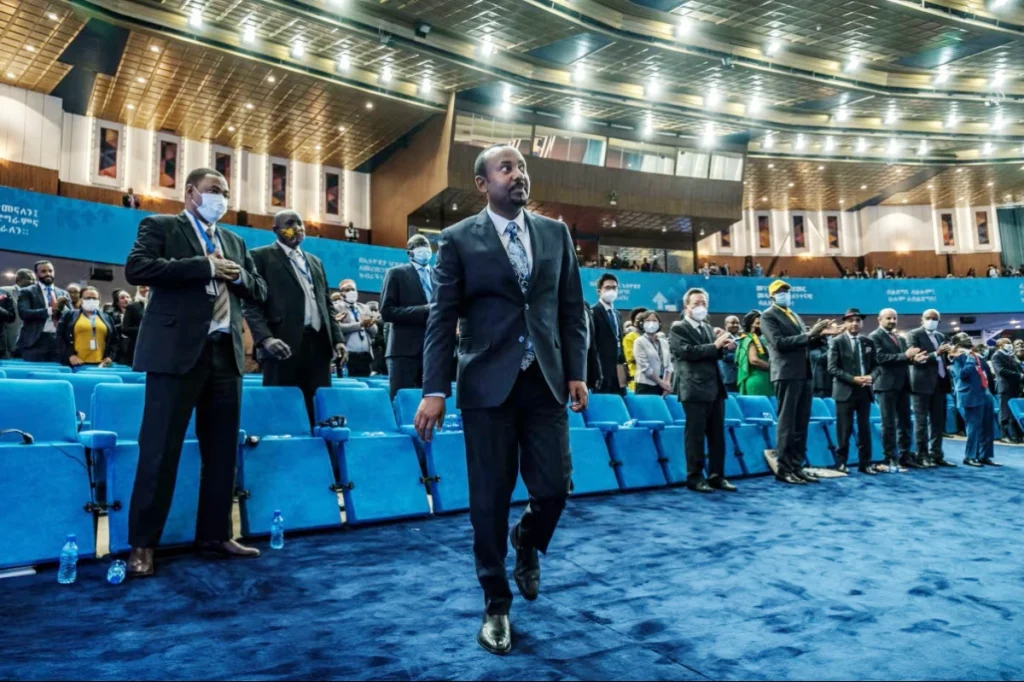
ADDIS ABABA — As Ethiopia prepares to hold its seventh general elections since the downfall of the military regime in 1991 on Monday, Prime Minister Abiy Ahmed and the ruling Prosperity Party are widely expected to secure a landslide victory.
But critics warn that growing restrictions on press freedom and political dissent are casting a shadow over the vote and with 70% of the country still affected by armed conflict, many question whether the conditions for a truly democratic election are in place.
While the whole northern region of Tigray, which has been trying to recover from a brutal civil war that ended in 2022, has been totally excluded from the poll, with conflict raging in parts of the country, many people will not be able to cast their votes.
Voters elect representatives to the 547-member parliament and the party that secures at least 274 seats earns the right to form the next government to lead the country in the next five years.
Abiy, 49, came to power in 2018 following widespread anti-government protests against the Ethiopian People’s Revolutionary Democratic Front (EPRDF), a coalition dominated by politicians from Tigray.
Aby offered a clean slate for Africa’s oldest uncolonized nation, which had been suffocated by decades of strict state control.
His predecessor, Hailemariam Desalegn, had overseen strong economic growth during his nearly six-year rule but continued a historical pattern of using violent crackdowns to crush dissent. This repression sparked years of protests and widened the divide between his government and the public, ultimately leading to his resignation.
Just 90 days into his premiership, Abiy stunned the world by negotiating a truce that ended a bitter 20-year civil war with neighboring Eritrea.
This rapid breakthrough, combined with early reforms such as releasing political prisoners and allowing a freer press, earned him the Nobel Peace Prize. It positioned him as a regional peacemaker and a domestic reformer, leading many to believe he would guide Ethiopia toward a free and democratic era.
However, that euphoria soon faded. Today, Africa’s second most populous nation with over 135 million people stands deeply divided, facing violent ethnic conflicts, restrictions on free speech and crackdowns on dissent.
Regions like Tigray, Amhara, and Oromia remain ravaged by active warfare, massacres, and mass displacement. Observers link these conflicts to Abiy’s push away from Ethiopia’s longstanding system of ethnic federalism, which had allowed diverse regional states to draft their own laws and maintain local armies.
For nearly three decades, the country was governed by the EPRDF, a coalition of four powerful, ethnically-based parties representing the dominant regions: Tigray, Amhara, Oromia, and the Southern Nations.
Abiy was initially brought to power by this coalition to calm tensions that forced his predecessor Desalegn to step down.
However, less than two years after taking office, Abiy dissolved the EPRDF, and replaced it with his Prosperity Party, a single national political organization that combined the former coalition with other ethnic minority parties. To further centralize authority, he ordered regional states to disband their local armies and integrate with the national military.
These reforms stripped the dominant Tigray People’s Liberation Front (TPLF) of its historical control of the regional government, driving it into active opposition. The policy also faced resistance in other regions, including Abiy’s native Oromia, where demands for regional autonomy grew.
As instability rose, the administration reverted to strict state control, detaining opposition figures and journalists while delaying elections. Tensions escalated when Tigray held regional elections in defiance of thata federal delay, leading to a political standoff that erupted into a civil war in November 2020.
This conflict, one of the deadliest in recent history, resulted in an estimated 600,000 casualties.
Today, Ethiopia faces active insurgencies not only in Tigray but Amhara and Oromia too, driven by disputes over autonomy, borders, and ethnic marginalization. This violence could keep millions from voting.
While Abiy called this Ethiopia’s most organized vote, logistical challenges and issues around electoral integrity remain. Additionally, opposition parties have reported political repression and administrative barriers.
Eyob Mesafint, leader of EZEMA, Ethiopia’s largest national opposition party, acknowledged the arrest and intimidation of his party members. He told CNN a week before the vote that these actions “reflect the persistence of undemocratic practices, particularly in areas where opposition parties are perceived to have stronger support.”
Prof Merera Gurdina, a veteran opposition politician and member of the Oromo Federalist Congress, alleges the upcoming election is the least competitive in Ethiopia’s recent history.
“We are participating symbolically because the law says you cannot boycott elections consecutively. We are participating, mainly to avoid deregistration,” he told the BBC.
Source: Saudi Gazette