


TAIZ — Heavy fighting between Yemeni government forces and Iran-backed Houthi rebels in southwest Yemen has left more than 300 people dead, as hundreds of families have abandoned their homes to escape the fighting.
The renewed violence marks the deadliest escalation in the country since a long-standing ceasefire collapsed.
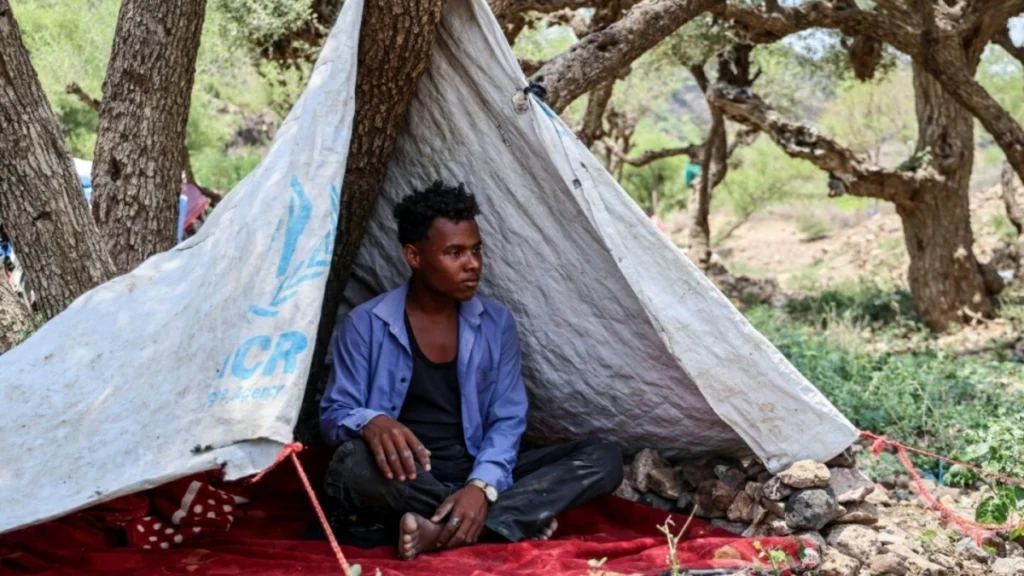
Families fleeing fighting in Maqbanah and Jabal Habashi in Taiz governorate in Yemen’s southwest took refuge at Al-Bareen camp for the internally displaced on Saturday.
On Sunday, AFP journalists saw displaced people with mattresses, livestock and other belongings setting up shelters in another camp in the area.
“The shooting came at us from above and from below,” said Rawdhah Hasan, a woman displaced from Maqbanah.
“They surrounded us from every direction; we fled with our children without even putting on our shoes,” she added.
Two military officials with the Yemeni government forces told AFP that 84 of their troops were killed between midday Saturday and early Sunday morning, mostly in missile attacks. Four Houthi military sources said 57 rebel fighters were killed in the same period.
According to an AFP tally compiled using various military and medical sources from both sides of the conflict, more than 300 combatants and some civilians have been killed since the start of the Houthi assault.
The two sides have been fighting for days over control of a gateway to the Red Sea, in the deadliest flare-up in the Arabian Peninsula’s southernmost country since a 2022 ceasefire collapsed in July.
The Houthis launched an offensive on Thursday aiming to cut off the government-held port city of Mokha, under fire for weeks, and advance towards areas bordering the Bab Al-Mandab strait at the southern entrance to the Red Sea.
A military official within the government said the rebels had succeeded on Saturday evening in “cutting off the road linking Taiz to Mokha.”
The UN agency for humanitarian coordination OCHA said on Friday that an estimated 1,790 households had been displaced following “intense shelling and clashes” in Maqbanah and Jabal Habashi districts.
A spokesman for UN chief Antonio Guterres said he was “deeply concerned by the ongoing military clashes,” warning of “devastating political economic and security ramifications for Yemen and its people.”
One military official with the internationally recognized government based in Aden said fighting had subsided in the early hours of Sunday morning.
The official said government “forces were able to establish positions for themselves north of Hays after advancing in the area”, referring to a frontline district less than 30 kilometres inland from the Red Sea coast.
But the official added the Houthis had advanced west of Taiz, south of Hays, in their push towards the Bab Al-Mandab.
Farea Al-Muslimi, a Middle East expert at the UK-based think tank Chatham House, said the Houthis were looking to exploit a weak front line at Mokha and “cut a lot of ties between Taiz and Bab Al-Mandab and Mokha.”
“If they have a chance to fully take over Bab Al-Mandab, they won’t hesitate for a second,” he added.
Adam Baron, a fellow at US-based think tank New America, said the Houthi offensive since Thursday had “shattered much of what was left of Yemen’s tenuous ceasefire”.
“Things increasingly appear to be on a path to escalation with few potential off-ramps,” he added.
With Iran’s closure of the Strait of Hormuz to commercial ships, the Bab Al-Mandab chokepoint has gained importance as a transit route, connecting Asia to Europe via the Suez Canal.
Source: Saudi Gazette