


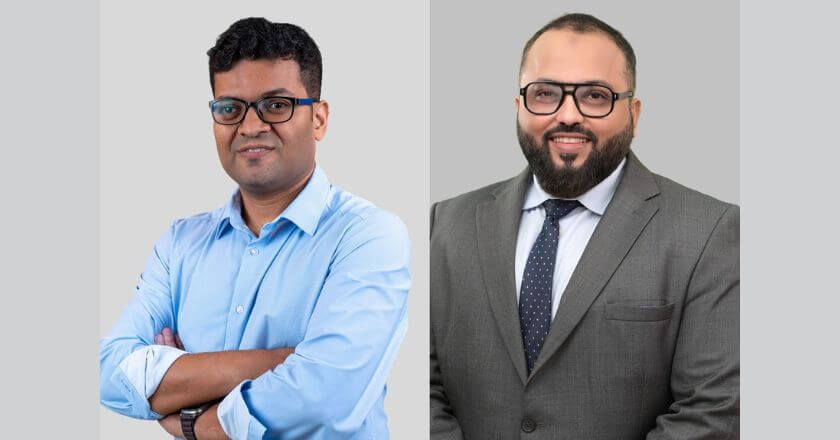
Rakshit Choudhary, CEO of Deriv.com, and Abdul Razzak, Manager, Career Services, BITS Pilani Dubai Campus, discuss AI-led fintech transformation, future-ready talent and a partnership moving beyond recruitment towards research, curriculum development and real-world innovation
Deriv.com and BITS Pilani Dubai Campus are expanding a relationship that has developed over several years from graduate recruitment and internships into a broader collaboration centred on artificial intelligence, skills development and industry-led learning.
BITS Pilani Dubai Campus has become an important source of technology talent for Deriv’s UAE operations, with the fintech company recruiting around 65 graduates, primarily for technical roles. Growing demand for AI, machine learning and agentic AI capabilities is now reshaping the skills Deriv seeks and opening new areas for collaboration between industry and academia.
A recently signed memorandum of understanding between the two organisations is expected to deepen that engagement through curriculum development, student projects, research and potential AI-focused facilities at the campus. The collaboration also reflects a wider shift taking place across the UAE, where universities and technology companies are working more closely to develop skills aligned with the country’s digital economy ambitions.
In this joint interview with Tahawultech.com, Rakshit Choudhary, CEO of Deriv.com, and Abdul Razzak, Manager, Career Services, BITS Pilani Dubai Campus, discuss the future of AI-powered fintech, evolving customer expectations, future-ready skills and the role industry-academia partnerships can play in strengthening the UAE’s technology ecosystem.
Interview excerpts
How will AI shape Deriv’s future, and what role does it play in the company’s contribution to the UAE’s digital economy?Rakshit Choudhary: AI will shape the future of fintech, just as it will influence many other industries. Over the past two years, Deriv has invested in AI research and recruited talent globally and within the UAE to work on advanced projects. Our internal motto is “automate everything”, but automation does not reduce the importance of people. In many cases, our strongest employees are busier because AI enables them to achieve more. We give teams access to different AI models and tools and encourage them to apply those technologies to relevant business challenges. Members of our UAE HR team, for example, are now developing AI-based tools without having to depend entirely on developers. Our objective is to help people build new capabilities while improving the speed at which the organisation can innovate. Customer-facing applications are another major area of focus. Trading can be complex and carries the risk of loss, so technology needs to help customers access clearer information, education and analytics. We are developing real-time commentary, insights and analytical capabilities using AI while ensuring customers remain responsible for their own decisions. The UAE provides a strong environment for this kind of innovation because of its willingness to adopt emerging technologies, attract international talent and support areas such as AI and digital finance.
How are changing customer expectations influencing Deriv’s technology and service strategy?
Rakshit Choudhary: Customers are becoming younger, more informed and increasingly comfortable experimenting with new technologies. Traditional approaches involving long brochures or large volumes of static information are less effective for customers who expect answers quickly and want services to be intuitive. AI gives us an opportunity to make support more interactive and relevant. Customers should be able to receive explanations when they need them, access useful information in real time and navigate products without unnecessary complexity. Trust remains fundamental. Deriv has operated since 1999, and our UAE entity obtained its licence in 2025. Customers need to understand the products and services they are using and have access to transparent information that helps them make informed decisions. Looking towards 2027, our priorities remain closely connected to this transformation. We want to attract and retain strong talent, expand automation across our operations and customer services, and use those capabilities to accelerate innovation.
AI can give teams the capacity to develop and improve services at a pace that was previously difficult to achieve.
What does the MoU with BITS Pilani Dubai Campus mean for Deriv’s talent and AI strategy?
Rakshit Choudhary: Our relationship with BITS Pilani Dubai Campus has grown through recruitment, internships and engagement with students. We have hired around 65 graduates from the campus, and we have been impressed by their confidence, technical capabilities and ability to take on responsibility. The memorandum of understanding gives us an opportunity to take the relationship beyond recruitment. Technology requirements are evolving quickly, particularly around AI, so companies need to work more closely with universities to prepare students for a changing workplace. We want to explore collaboration around courses, curricula, AI and machine-learning projects and potentially research initiatives. Connecting students and faculty with real-world technology problems can help build skills that are relevant to industry while also giving our teams access to new thinking and emerging talent. BITS Pilani Dubai Campus has an enthusiastic student community and plans to strengthen its focus on AI and computing. We would like to contribute industry expertise while helping students develop practical experience that can prepare them for future technology careers.
How is BITS Pilani Dubai Campus supporting the UAE’s digital-first ambitions?
Abdul Razzak: Digital transformation has long been integral to how BITS Pilani Dubai Campus teaches, operates and prepares students for the future. Our focus has evolved from digital adoption to digital innovation and capability building, creating opportunities for students to use technology to address institutional and industry real challenges. For example, our Career Services team proposed an AI-enabled career platform that was developed by a student. It enables students to record interviews, giving employers an additional way to assess talent beyond the conventional CV. Alongside such initiatives, we are expanding access to digital certifications, industry-aligned learning and technology-enabled career development.
Our aim is to develop digitally confident professionals and innovators who can contribute meaningfully to the UAE’s AI, digital transformation and knowledge-economy ambitions.
What makes BITS Pilani Dubai Campus students attractive to technology employers such as Deriv?
Abdul Razzak: What makes BITS Pilani Dubai Campus students attractive to technology employers is the combination of strong technical foundations, practical exposure and the ability to adapt to rapidly changing technology requirements. Our students are encouraged to build products, solve real-world problems and apply their learning beyond the classroom, while developing communication, teamwork and business understanding alongside technical skills. A key differentiator is that internships are embedded into the academic journey, giving students meaningful workplace exposure before they enter the graduate recruitment process. They also take ownership of major campus initiatives, gaining experience in leadership, collaboration, planning and execution. As a result, employers are not simply meeting students with good academic credentials; they are meeting candidates who can demonstrate projects, industry experience and the ability to work in real-world environments. Our engagement with technology employers such as Deriv also reflects this adaptability. Their requirements have evolved from software and full-stack development towards AI, machine learning and, increasingly, agentic AI. Students who have built relevant projects and developed these emerging capabilities are able to respond to those changing requirements.
Combination of technical depth, hands-on experience and adaptability is what makes our students particularly relevant to technology-driven employers.
How will the Deriv partnership and new academic programmes prepare students for future technology careers?
Abdul Razzak: The Deriv partnership is an opportunity to move beyond traditional recruitment and build a stronger industry–academia talent pipeline. While hiring will remain an important component, we see significant potential for Deriv’s expertise to contribute to curriculum development, student projects, career mentoring and emerging technology initiatives. Discussions around AI and a potential AI-focused centre could give students opportunities to work on real-world products and problems alongside industry professionals. This is closely aligned with how we are evolving our academic portfolio. We are introducing programmes in areas such as AI, cybersecurity, robotics, sustainability and aerospace, with a focus on combining strong fundamentals with hands-on, industry-relevant learning. The proposed four-year AI Engineering programme is one example of this direction. Ultimately, the objective is not simply to prepare students for the jobs available today, but to anticipate where technology and industry are heading. By combining industry partnerships such as Deriv with future-focused academic programmes and applied learning, we aim to develop graduates who can contribute from day one and continue to adapt as technology evolves, supporting the UAE’s transition towards a more AI-driven, knowledge-based economy.
Source: Tahawul Tech