


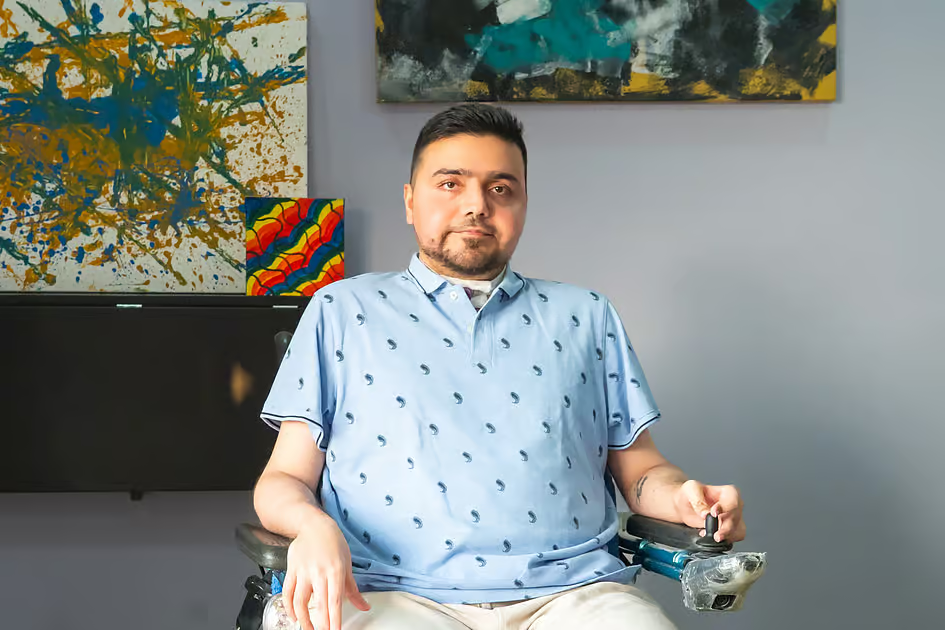
For seven years, Farah Libardee returned to Sharan Budhrani’s home and his world: to long conversations in his studio, messages and poems sent across cities, and time spent listening not only to Sharan but to the people who have held his life together. There were the difficult medical chapters, the tracheostomy, the hospital stays and the wordless months. There was also painting, football, speeches, friends, family, and the wry humour that has survived even the darkest moments.
The result is Chasing Kites, a deeply personal, multi-perspective biography that Farah has given to Sharan — a book that preserves his journey while he is still here to be part of the telling.
Its central figure is a Dubai-born artist, speaker and accessibility advocate who was diagnosed with Becker muscular dystrophy at nine. The progressive condition has steadily weakened his body, changed how he communicates and made daily life a meticulous exercise in adjustment. Yet the book refuses to place illness at the centre of Sharan’s identity.
“What we didn’t want — what I didn’t want, and I think Sharan didn’t want either — was for it to be about feeling pity for Sharan,” says Farah. “He is a very complete young man with many good thoughts and he can express himself very well.”
That insistence runs through the book’s title. Chasing Kites emerged from Sharan’s love of flying kites, but Farah says the image grew into something larger. “It is about freedom. It is about letting go,” she says. “If you read the book, you see how he has grown spiritually. He is letting go of all these earthly matters.”
For Sharan, who now spends much of his day in bed, freedom has never been a vague idea. It has been a ramp, a power wheelchair, a Metro lift, a carefully placed entrance door or the ability to make an order at a restaurant without someone speaking over him. It has also been the freedom to be seen as a person rather than a condition.
“When you see someone in a wheelchair, I don’t know, it just comes to them naturally that maybe we should talk to the person who is accompanying him, not to the person in the wheelchair,” he says.
His mother, Mansha, vividly remembers the early signs before diagnosis… the frequent falls, the enlarged legs and the uneasy feeling that her son was struggling with more than childhood clumsiness. In October 2001, after another fall, a doctor told her he suspected muscular dystrophy. A biopsy in Bangalore confirmed the diagnosis.
Sharan recalls the bewilderment of being nine and hearing that there was no cure. “I didn’t know what to say,” he says. “Because at that age, you don’t really understand this notion of there being no cure. What does that even mean?”
For Sharan, school also became isolating. He walked differently, could not take part in sports and fell often. “There were very few friends,” he says. “They called me names and so many things were going on. That made me very sad, made me a very quiet person.”
But the quiet child eventually became a speaker who has addressed audiences at universities and events, often to standing ovations. He became an artist too, finding painting at a time when his health disrupted his education and he was unable to sit long enough to complete his Grade 12 exams.
“I sat at home without knowing what my future was, but I picked up a paintbrush and I just started putting paint on paper,” he says. “I liked seeing the colours on paper and then I realised that maybe I could do art.”
As his muscles weakened, Sharan adapted his creative process, using remote-controlled cars, spoons and sticks to move paint across large canvases. The approach led him to exhibit as a solo artist at Sikka in 2018 and he later received the UAE Golden Visa for his contribution as an artist.
That determination to alter the environment, rather than disappear from it, shaped Sharan’s advocacy. He and his family were early voices pushing for better wheelchair access in Dubai, raising concerns about ramps, parking spaces and kerbs. Sharan learned the Metro with a problem-solver’s precision, mapping the carriage door that would place him nearest the lift upon arrival.
“It was a sense of freedom,” he says of travelling independently. When access is missing, he photographs it and writes to the relevant authority. “In a few places I was able to get wheelchair access, and it made me feel very good, made me feel motivated to do much more for the community.”
His mother’s approach has evolved alongside her son’s condition. For years, the family searched relentlessly for a cure, travelling, consulting doctors and trying treatments. But after a stem-cell intervention brought little change, Mansha made a decision that would alter the rhythm of their lives. “Instead of running from pillar to post, let’s improve your life now,” she told him.
There came the power bed, power wheelchair and power car — tools that made independence possible, rather than treating the dependence as defeat. “On his 21st birthday, Sharan got a power wheelchair,” Mansha recalls. “He could go from here to the office and into the parking lot by himself.”
The medical reality, however, has remained unforgiving. In 2018, Sharan was hospitalised and fell into a coma. When he awoke, surrounded by the sounds of machines and a ventilator, doctors explained that his breathing muscles had weakened. He required a tracheostomy to clear his lungs. “The first few days, I had lost interest in life,” he says. “I saw myself in a very dark tunnel. There was no coming back.”
For three months after the procedure, he could not speak. He communicated through a handwritten numerical code. One for calling his mother, two for being repositioned, three for a bedsore, four for calling his father. Farah, who had been writing the book through these years, watched him try to make himself understood. “Imagine the frustration you feel when you cannot speak,” she says.
But even there, Sharan found room for humour. Farah remembers tears running down his face as they looked at one another during his recovery. Then he wrote, “I have something in my eye.”
The book includes those hard passages, but it also deliberately makes room for Nuru (Nurudeen), Sharan’s caregiver, for his sister and father and, crucially, for Mansha, his closest partner in a life of continuous care. “We inspire each other. We give strength to each other,” Sharan says of his mother.
For Farah, the emotional meaning of Chasing Kites became clearest at a reading, when Mansha told her the book had given her a reason to carry on even if a day came when Sharan was no longer with her. “That was a very emotional moment,” Farah says.
Farah understood, perhaps instinctively, the dynamics of a family shaped by disability. Her own sister was paralysed from birth and died at 11, when Farah was nine. “For me, she is my angel,” she says. “She’s always with me.”
She sees Sharan not simply as a subject but as a teacher. “When I met him for the first time, Sharan was completely different from who he is now,” she says. “He has grown into this wonderful person. For me, he has been a teacher. My friend, but also my teacher.”
Sharan himself does not offer an easy formula for keeping the hope and optimism intact. “It’s not easy,” he says. “You just have to keep finding ways to make things easier and more accessible.”
These days, his philosophy is less about chasing a cure than fully inhabiting the moment he has. “Now it’s about living day to day. Each day as it comes,” he says. “Sometimes we just have to make it happen. We need to seize the moment.”
In Chasing Kites, that is the truth Farah has tried to capture on the pages. Not a life defined by its limits, but a man still reaching for freedom, still finding meaning, still chasing the sky.
The book is available for purchase via HarperCollins India, Amazon India and Amazon UAE.
Source: Khaleej Times