


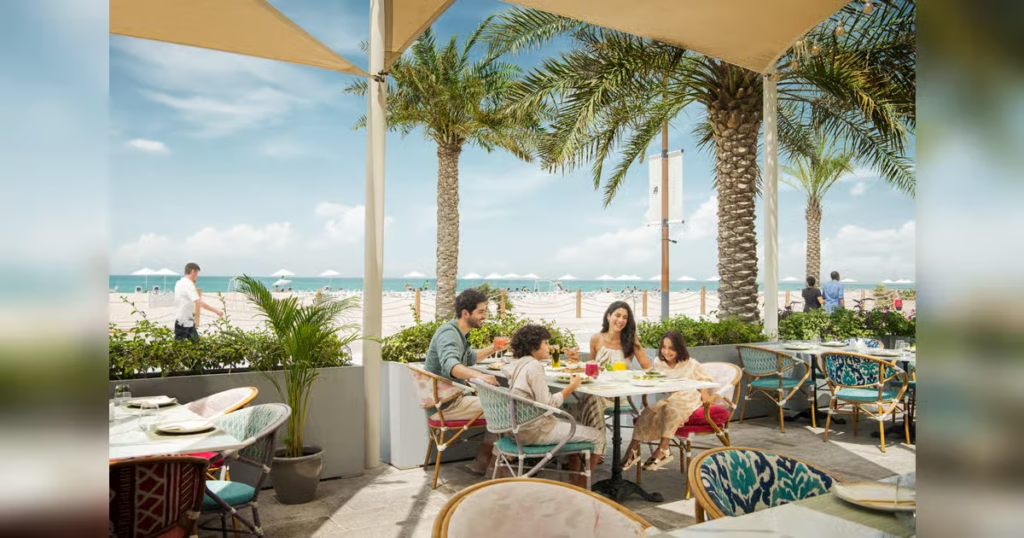
Two decades ago, Saadiyat Island was little more than a stretch of undeveloped coastline off Abu Dhabi. Today, the same island has become one of the UAE’s most coveted luxury addresses, where residents can spend the morning walking along white-sand beaches, the afternoon inside a world-class museum, and the evening between waterfront restaurants and private beach clubs. Multimillion-dollar villas now sit alongside a growing cultural district anchored by institutions like the Louvre Abu Dhabi.
For years, luxury real estate in the UAE has almost always been synonymous with Dubai. The Palm Jumeirah, Downtown Dubai, and the city’s skyline became shorthand for Gulf ambition and ultra-luxury living. But while Dubai built its reputation on scale and spectacle, Abu Dhabi has been quietly developing a different kind of luxury story.
Saadiyat Island’s appeal has never been about trying to recreate the Palm per se. Instead, it has been built around a different lifestyle: private beachfront homes, protected coastline, and a slower pace that puts residents close to the city. For buyers, the draw is not just owning a luxury property but having a place that feels removed from the noise yet connected to everything Abu Dhabi and Dubai are becoming.
That momentum is showing up in the numbers. According to Savills’ Abu Dhabi Residential Market Report Q2 2026, Abu Dhabi recorded around 7,129 residential transactions in the first half of 2026. Saadiyat stood out within that market, with residential sales on the island surpassing Dh200 million during the reporting period, representing a 108 per cent increase compared with the same period last year.
The island has also maintained its position at the top end of Abu Dhabi’s villa market. In the first half of 2026, average villa prices on Saadiyat reached approximately Dh26,500 per square metre, up 8 per cent year over year, according to Clare Moukabaa, partner of residential consultancy, Knight Frank MENA. While growth has moderated from the 28 per cent annual increase recorded previously, Saadiyat remains Abu Dhabi’s most expensive villa market and continues to command a clear premium over other locations, Moukabaa explained.
Ali Ishaq, director and head of residential at Savills Abu Dhabi, argues that Abu Dhabi’s luxury market still has room to run. Compared with established global cities, he said prices remain relatively attractive to international buyers. “From an outsider’s perspective, if you look at the World Index, it’s still not an incredible price per square foot. It’s not mind-blowing,” he said. “But then the international buyer comes in and goes, ‘Well, I compare that to London or New York, and that’s quite cheap.’”
That gap, Ishaq said, is part of what continues to attract international buyers who see Abu Dhabi’s luxury market as offering relative value compared with other global destinations. Savills’ data also shows Saadiyat recording the highest villa capital values among Abu Dhabi’s key residential locations, reinforcing its position as the city’s benchmark for luxury living.
The numbers reflect a broader shift in how wealthy buyers are viewing Abu Dhabi. They are no longer looking at the emirate purely as an investment opportunity, but as a place to live, raise families and build a lifestyle.
“Saadiyat definitely leads the way… It’s the crème de la crème of Abu Dhabi,” he said. “You hear Yas Island, and it is famous for its own reasons, but Saadiyat has become equally as popular among higher-end buyers.”
Saadiyat’s rise, however, is not being driven by one single factor. Industry experts say the island’s appeal comes from a combination of lifestyle, location, and scarcity. “Once the island had established homes, beach resorts, a golf club and beach clubs, it began to feel like a complete luxury destination rather than somewhere that was still emerging,” Moukabaa said. Saadiyat offers the increasingly rare opportunity to own a prime waterfront home within a lower-density community. Additionally, Moukabaa says, “The cultural district and the growth of its restaurant and leisure offerings have strengthened that position over time.”
Saadiyat’s transformation is also changing who is buying in Abu Dhabi. While earlier demand was largely driven by local residents and investors, real estate experts say the island is increasingly attracting international high-net-worth buyers who see Abu Dhabi as more than a place to park capital.
Moukabaa said the island’s buyer profile has become younger and more international, with entrepreneurs and business owners from Europe and Asia increasingly purchasing homes in Abu Dhabi. Ishaq said he is seeing the same trend firsthand, with many of his clients relocating to establish businesses or take advantage of the emirate’s growing financial sector, particularly around the Abu Dhabi Global Market (ADGM).
Interestingly, despite the fact that Abu Dhabi and Dubai have been seen as competing destinations for high-net-worth buyers, Ishaq said more people are beginning to view them as complementary, with each city offering something different. “Go to Saadiyat, and you’ll actually see a lot of Dubai plates,” Ishaq said. “People from Dubai leave on the weekend and come to Abu Dhabi for that Saadiyat lifestyle. We’ve also seen a lot of high-net-worth clients in Dubai buying homes in Hidd Al Saadiyat and using them as weekend homes.”
For Ishaq, Dubai license plates are a sign of how buyer behaviour is changing. Saadiyat is no longer attracting only overseas investors or Abu Dhabi residents. Increasingly, affluent Dubai residents are choosing the island as a second home or weekend retreat.
The demand for real estate in Saadiyat has continued against the backdrop of wider regional uncertainty. When the war between the US and Iran began earlier this year, Ishaq expected some impact on buyer sentiment, but said the market proved more resilient than anticipated. “What surprised me the most is how resilient Abu Dhabi has been compared to our counterparts around the GCC,” Ishaq said.
He said that resilience was also reflected in the lack of distressed sales after the slowdown. While some buyers expected to find opportunities from owners needing to sell quickly, Ishaq said that never materialised. There haven’t been many owners panic-selling properties, Ishaq explained. He did, however, get a handful of clients asking him to headhunt distressed deals. “There were none. We couldn’t find them,” Ishaq said.
Saadiyat’s next chapter will entirely depend on how the island manages growth without losing the scarcity that helped drive its initial appeal. While limited supply has been one of the biggest factors behind rising prices, more residential inventory is now planned. According to Cushman & Wakefield Core’s most recent Abu Dhabi residential report, Saadiyat Island currently accounts for 14 per cent of the emirate’s planned residential supply pipeline, behind Yas Island and Reem Island. Despite the incoming supply, Saadiyat continues to command the highest values across Abu Dhabi’s villa market, reinforcing the challenge developers face: expanding the island without diluting what made it desirable.
Much of Saadiyat’s future growth is being driven by Aldar, which has positioned the island as one of the cornerstones of Abu Dhabi’s luxury residential strategy. However, Saadiyat’s transformation has happened in stages; the island did not become a luxury address overnight.
Mamsha Al Saadiyat was one of the projects that helped change how people viewed the island. Instead of being known only for large villas, Saadiyat began attracting buyers looking for a more connected beachfront lifestyle, with apartments, townhouses and penthouses overlooking the coast, along with restaurants and retail just steps away from the beach. Prices start from around Dh2.4 million, giving buyers a different entry point into the island’s luxury market.
For those looking for more space, Saadiyat Lagoons offers a different vision of luxury living. The villa community is built around protected mangroves and nature trails, appealing to families who want privacy without feeling removed from Abu Dhabi. The development includes 610 villas, ranging from four to six bedrooms, with completion expected in 2027.
Developments like Saadiyat Grove and The Row are helping create more of a neighbourhood feel on the island, bringing together restaurants, retail and public spaces near the Cultural District. The goal is not just to create places where people own property, but places where they actually want to spend their time.
But perhaps the biggest shift in Saadiyat’s luxury story has been the rise of branded residences. Nobu Residences, for example, has pushed Saadiyat further into the ultra-luxury segment, with apartments starting around Dh8 million and penthouses reaching more than Dh137 million. The upcoming Nobu Hotel Saadiyat is expected to further strengthen the island’s appeal by adding another internationally recognised hospitality brand to its growing luxury ecosystem. Meanwhile, Baccarat Residences and Louvre Abu Dhabi Residences are built around the idea that luxury today is increasingly tied to experiences: design, hospitality, culture, and access.
All the momentum Saadiyat has seen so far does not mean the island will be the only luxury destination in Abu Dhabi. As other communities continue to develop, places like Yas, Jubail, and Hudayriyat Islands will bring more options to the market.
“Yas, Jubail and Hudayriyat Islands will provide strong alternatives as they develop, but each offers something different. I see that additional choice as a positive development for Abu Dhabi’s luxury market rather than something that will take away from Saadiyat’s position,” Moukabaa said.
The bigger question now is whether Saadiyat can continue to grow while holding on to what made it stand out in the first place: its privacy, space and sense of exclusivity. Ishaq believes the island’s next phase will only build on that foundation, as more hospitality, cultural, and residential projects come to market. “I do expect Saadiyat to remain Abu Dhabi’s standout luxury market,” Moukabaa said. “It has an established identity, exceptional beaches, cultural institutions and a relatively limited supply of prime villas, all of which are difficult to replicate.”
To Ishaq, Saadiyat’s story is no longer about convincing buyers that the island has potential. “That already exists today on Saadiyat. I think as time goes on, it will only get better,” he says.
Source: Khaleej Times