
Close Menu
    What's New

    Hamas announces dissolution of Gaza governing body

    July 6, 2026

    Sharjah Chamber Board reaffirms commitment to advancing comprehensive economic development

    July 6, 2026

    Why some pets seem better, until they’re not, exprts weigh in

    July 6, 2026
    Facebook X (Twitter) Instagram
    Facebook X (Twitter) Instagram
    The Gulf GazetteThe Gulf Gazette
    • Home
    • KSA
    • UAE
    • GCC
    • Technology
    • Lifestyle
    • Sports
    The Gulf GazetteThe Gulf Gazette
    Home»Sports»Earth reaches farthest point from Sun Monday night
    Sports

    Earth reaches farthest point from Sun Monday night

    Editorial TeamBy Editorial TeamJuly 6, 2026
    Facebook Twitter Pinterest LinkedIn Tumblr Email
    Share
    Facebook Twitter LinkedIn Pinterest WhatsApp Email


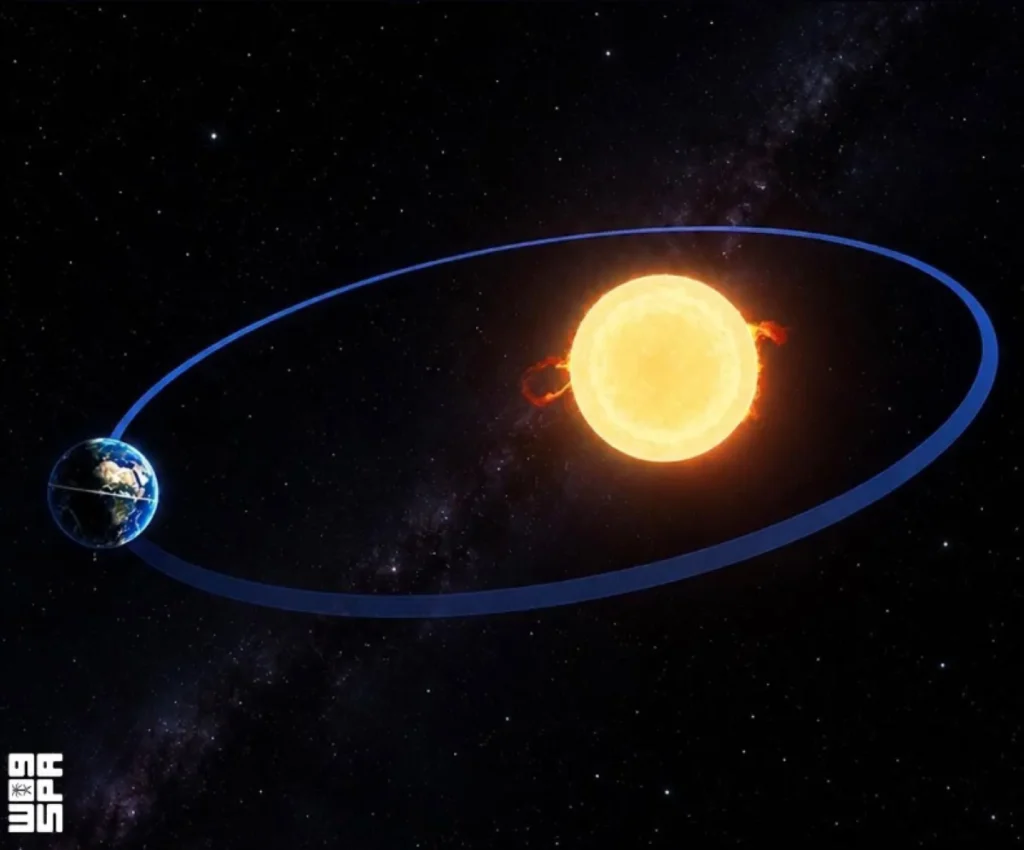
    JEDDAH — Earth will reach aphelion Monday night, its farthest point from the Sun in its annual orbit, at 8:30 p.m. Makkah time, according to the Jeddah Astronomical Society.

    The distance between the Earth and the Sun will be approximately 152 million kilometers.

    The annual astronomical event confirms that the changing of the seasons is determined by the Earth’s axial tilt rather than its distance from the Sun.

    Majed Abu Zahra, President of the Jeddah Astronomical Society, said that reaching aphelion does not result in lower temperatures, as the seasons are governed not by the Earth’s distance from the Sun but by its 23.4-degree axial tilt, which causes the Northern Hemisphere to receive the Sun’s rays at a steeper angle during summer.

    He noted that the Earth travels more slowly in its orbit at aphelion, making summer in the Northern Hemisphere slightly longer than winter.

    Abu Zahra added that the Earth’s orbit is elliptical, causing its distance from the Sun to vary by about 5 million kilometers over the course of a year.

    As a result, the Sun appears slightly smaller at aphelion than at perihelion, although the difference is not visible to the naked eye.

    These phenomena, according to Abu Zhara, are part of the Earth’s natural orbital variations, which help scientists better understand climate patterns and the evolution of the seasons over time.

    Source: Saudi Gazette

    Previous ArticlePeople, not technology, decide fate of AI projects, says NCST official
    Next Article Iron deficiency affects up to 30% of children, UAE doctors warn

    Related Posts

    Grand Mosque cooling system keeps temperatures at 22–24°C

    July 6, 2026

    Millions of mourners fill Tehran streets for Khamenei’s funeral procession

    July 6, 2026

    GASTAT launches survey to measure Saudi Arabia’s digital economy

    July 6, 2026
    Latest Posts

    Hamas announces dissolution of Gaza governing body

    July 6, 2026

    Sharjah Chamber Board reaffirms commitment to advancing comprehensive economic development

    July 6, 2026

    Why some pets seem better, until they’re not, exprts weigh in

    July 6, 2026

    Sandisk bets on all-flash future for UAE’s digital economy, says Ghassan Azzi

    July 6, 2026
    Don't Miss

    Hamas announces dissolution of Gaza governing body

    By Editorial TeamJuly 6, 2026

    GAZA CITY — Hamas announced on Monday the dissolution of the body that has governed…

    Austria’s inflation rate up by 0.9% to 3.1% in March

    April 1, 2026

    Saudi FM, UN chief discuss regional developments in phone call

    April 1, 2026
    2026. All rights reserved.
    • KSA
    • UAE
    • GCC
    • Technology
    • Lifestyle
    • Sports

    Type above and press Enter to search. Press Esc to cancel.