


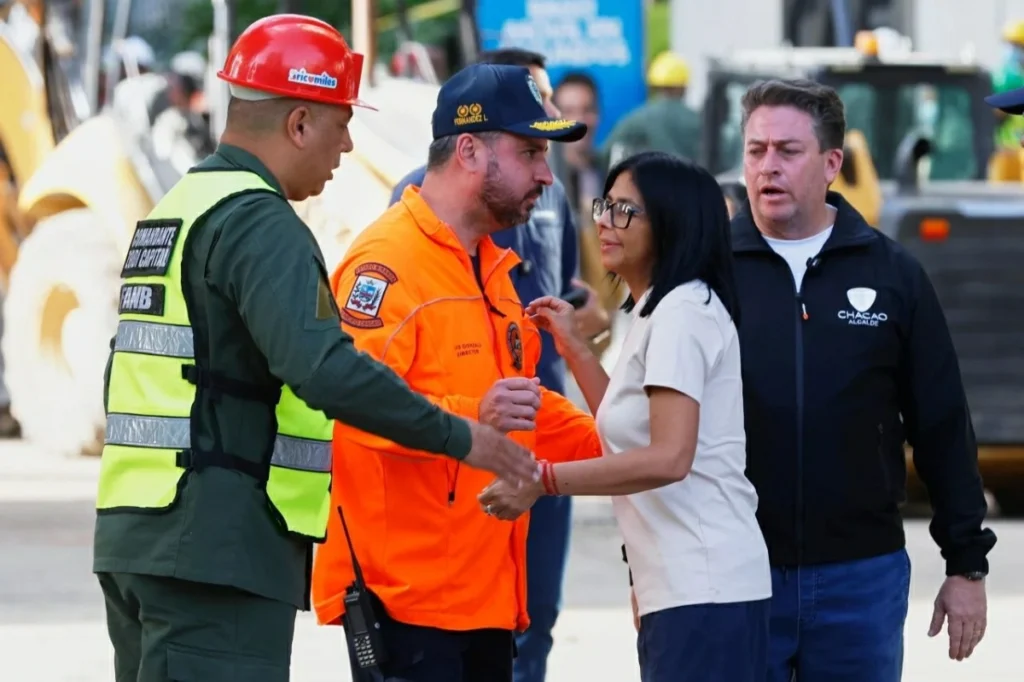
CARACAS — Venezuela’s acting President Delcy Rodríguez announced on Sunday the creation of a presidential commission to assess the condition of housing and infrastructure damaged by the powerful earthquakes that struck the South American country, and extended school closures for another week.
“This presidential commission is already working to verify habitability conditions, to determine whether people can safely return to their homes,” Rodríguez said during a broadcast on state television channel Venezolana de Televisión (VTV).
The acting president said the commission will be headed by engineer Francisco Garcés and will include public institutions, engineering organizations, and universities.
Rodríguez also explained that authorities will use a traffic light system — green, yellow, and red — to classify the safety of homes.
“There is still a lot of fear among those whose homes were affected, but there are external signs that do not necessarily match structural damage,” she added.
Rodríguez, who assumed office after Nicolás Maduro was captured by the United States last January, also announced the creation of a “task force” responsible for establishing temporary camps for those who lost their homes and for planning housing reconstruction projects “in a very short timeframe.”
The commission will be chaired by her brother, National Assembly President Jorge Rodríguez.
In La Guaira, the area hardest hit by the earthquakes, Rodríguez said electricity service has been restored by 75%, potable water by 68%, and road infrastructure by 90%.
According to the United Nations Development Programme (UNDP), the earthquakes in Venezuela affected nearly two million buildings and caused direct damages totaling $6.7 billion.
UNDP says preliminary estimates indicate direct economic losses of about 6% of the Gross Domestic Product of the five most affected states, including the capital district of Caracas and the Yaracuy state, where the earthquake’s epicenter is located.
Total losses, including indirect economic effects, could be nearly three times the initial estimates, UNDP reports.
According to UNDP, about 8.6 million people were in the seismic intensity zone capable of causing at least moderate damage to infrastructure. The largest number of affected people live in the northern part of Venezuela. Of the 1.7 million damaged buildings, 1.2 million are located in areas with strong ground shaking, and about 5,000 in zones with the highest earthquake intensity.
UNDP’s assessment demonstrates the scale of the potential economic impact on a country that, even without the earthquake, was in a difficult financial situation.
After the detention of President Nicolás Maduro by US forces, some sanctions against Venezuela were eased. At the same time, the country continues to experience a sharp shortage of financial resources due to long-standing US restrictions on oil exports, from the consequences of which the country is still partly recovering.
The government and international partners expect coordination on infrastructure reconstruction and support for the most vulnerable regions.
Source: Saudi Gazette