


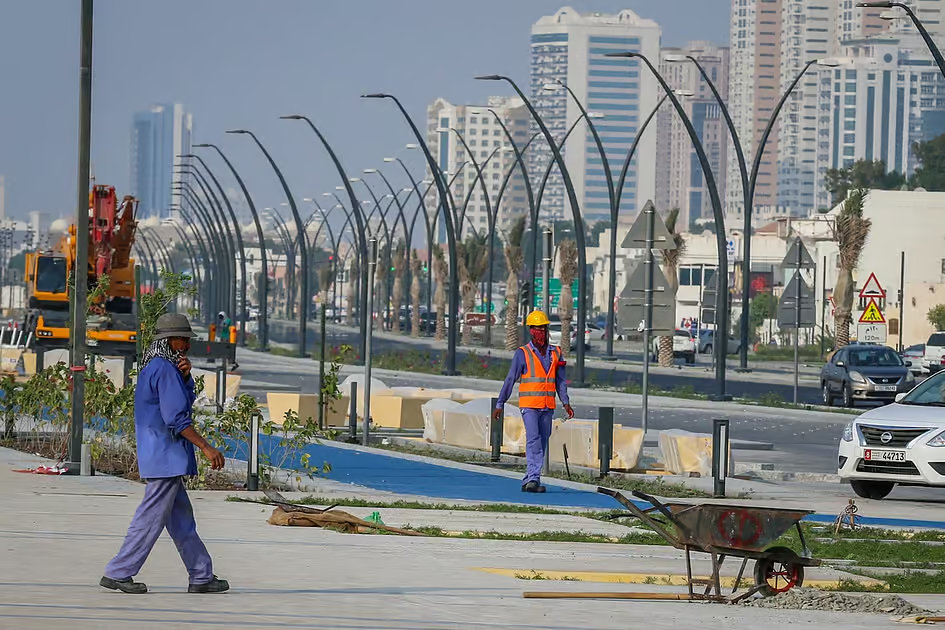
Residents living around Jamal Abdul Nasser Street, Al Taawun, Al Khan, and parts of Sharjah’s Industrial Area said they are among the most affected by ongoing roadworks and traffic diversions, which began two weeks ago.
What started as small adjustments to daily commutes has now, for many, turned into a complete reshaping of routines — with residents planning their entire day around congestion and road closures.
Some residents have started parking more than a kilometre away from home, others are splitting work between home and office to avoid peak-hour traffic, while parents are coordinating school runs in shifts. Neighbourhood WhatsApp groups have also become a key tool for sharing parking updates and organising carpools.
Stay up to date with the latest news. Follow KT on WhatsApp channels.
With the first phase of the wider road improvement project expected to be completed later this year, residents said they are adapting for now while hoping for smoother travel in the months ahead.
Sharjah residents shared with Khaleej Times how they are coping with the situation:
1. Working around traffic, not through it
For Amit Sarda, who works at a shipping company and lives near Al Khan, adjusting his working hours has made commuting more manageable.
Handling Turkey accounts allows him to split his workday. He now works from home from around 8am until 11am, completes his local work, and then drives to the office after the morning rush has eased. Since his Turkish clients become active later in the day, he finishes the rest of his work from the office and leaves later in the evening.
“It works well because of the time difference. I avoid the heaviest morning traffic and still complete my work,” he said.
The arrangement has also given him more time with his wife in the mornings instead of spending those hours behind the wheel.
2. Parking far from home
For Fahim Abbas, who lives on Jamal Abdul Nasser Street, reaching home no longer means parking outside his building. With some roads closed for construction, he now parks wherever he can find a space, often on Al Ittihad Road, before walking the remaining distance home.
“Sometimes I walk more than a kilometre after parking. It’s not ideal, but until the work is completed, this is the easiest option,” he said.
He added that parking spaces on accessible roads fill up quickly, especially during the evening.
3. Carpooling to save time, money
For Naseem Ahmed, a master cutter who lives in Al Khan and works in Abu Hail, driving all the way home no longer makes sense. Instead, he uses a carpooling service that drops him as close as possible before he walks to his building.
“It saves me the hassle of driving through the diversions every day. I don’t mind walking a little if it means avoiding the worst traffic,” he said.
Taxi drivers also told Khaleej Times that more passengers are now asking to be dropped near the affected areas rather than directly outside their buildings because vehicles cannot reach some entrances.
For Sajjad Ahmed, who travels from Al Taawun to Al Quoz, carpooling has also become part of his daily routine. Four colleagues now travel together, sharing fuel and Salik costs. “We are saving around Dh100 a week each. More importantly, we have company during the journey instead of driving alone,” he said.
4. Parents taking turns on school runs
Road works have also changed mornings for families. Asfiya Tanzeem, a mother of two, said dropping children to school had become more challenging because of the diversions.
To make life easier, three families decided to work together. “We now take turns dropping seven children to school. One parent drives on one day, another takes over the next. It has made mornings much easier,” she said.
With schools closing for the summer next week, she expects some temporary relief before classes resume.
5. Using technology to solve local problems
Residents said neighbourhood WhatsApp groups have become more active than ever. Instead of simply exchanging greetings, some groups are now being used to share available parking spaces, road updates, carpool requests, and alternative routes.
Residents said these community groups have helped them find parking faster and coordinate daily travel.
6. Walking the last kilometre
One of the biggest changes has been the amount of walking residents now do. People who once drove directly into their residential buildings are now being dropped off at nearby junctions before walking the remaining distance home.
Residents also said that the pedestrian subway near Sharjah City Centre is seeing heavier use than before as commuters cross between drop-off points and nearby residential neighbourhoods.
Shahriyar, a delivery rider said he has also had to adapt. “In some areas I can no longer stop close to the building. I park where I can and walk the rest of the way,” he said.
7. Looking beyond the inconvenience
Despite the disruption, residents said they understand why the projects are being carried out.
Some residents said that they are willing to accept a few months of inconvenience if it results in smoother traffic in the long run. “The roads are being upgraded for everyone. Right now we are adjusting our routines. Hopefully, once the projects are completed, the commute will become easier for all of us,” said Ahmed Saeed, a resident of Al Tawun in Sharjah.
Source: Khaleej Times