


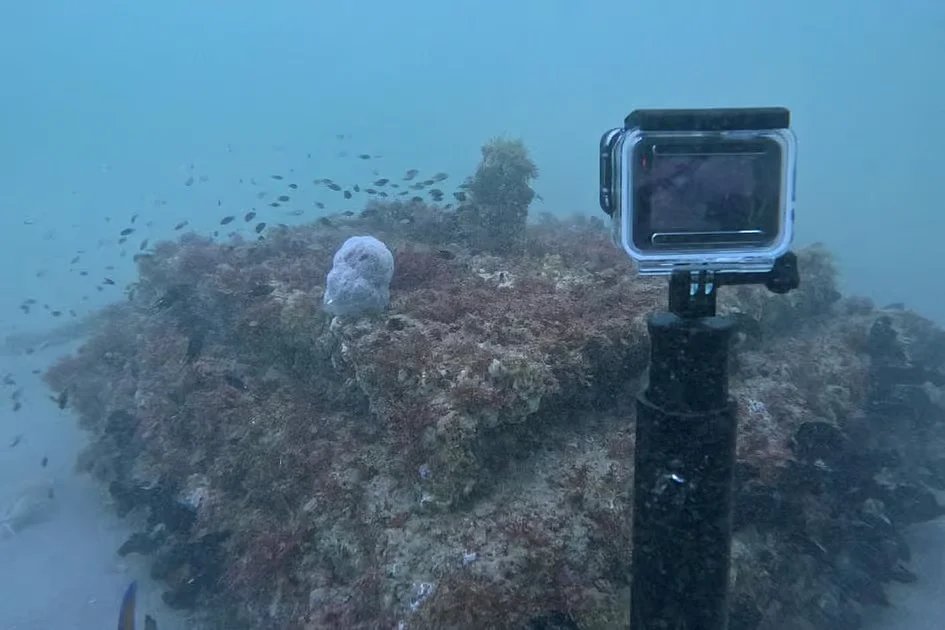
Just metres beneath the surface off Fujairah’s coast, clouds of juvenile fish darted in and out of specially designed reef structures as divers descended to examine what one marine scientist describes as the culmination of a 25-year idea.
For more than two decades, marine ecologist Dr Aaron Bartholomew carried around an idea he believed could change the way artificial reefs work.
The concept first took shape during his PhD research in 2001, long before conversations about biodiversity loss, climate resilience, and nature-positive infrastructure became mainstream. While many artificial reefs were designed to attract large fish, Bartholomew was focused on a different question: how could artificial structures help young fish survive?
Twenty-five years later, that idea is now sitting beneath UAE waters.
On World Oceans Day, researchers, government representatives, divers and environmental specialists took part in an underwater demonstration of Ecoreef, an eco-engineered mooring block developed by UAE-based Ecocoast in collaboration with marine ecologist Dr Aaron Bartholomew.
The structure is designed to create refuge for juvenile fish by incorporating small spaces that allow young fish to hide from predators while they grow.
For Bartholomew, seeing the results for the first time was deeply personal.
“I’ve been thinking about these sorts of issues since my PhD in 2001,” he told Khaleej Times after emerging from the dive site
“I basically thought about this sort of reef back then. Since then, I’ve talked to various people at conferences and other artificial reef companies, but Ecocoast finally sat down with me and let me guide the design and construction of these reefs.”
Why traditional artificial reefs fall short
According to Bartholomew, many conventional artificial reefs create the illusion of success.
Large concrete structures often attract adult fish such as snapper and hammour, leading observers to conclude that marine life is thriving.
But he argues that attracting existing fish is not the same as producing new fish.
“What you’re doing is attracting adult fish that already exist,” he said. “You’re not producing new fish, you’re just rearranging existing fish.”
Instead, Ecoreef was designed around juvenile fish survivorship. The structures contain protected spaces where tiny fish can shelter from predators during the most vulnerable stage of their lives.
Natural nursery habitats such as mangroves, seagrass beds and coral reefs perform this role in the wild. Bartholomew describes Ecoreef as an artificial version of that nursery environment.
During monitoring dives in Fujairah, researchers observed large numbers of juvenile fish using the structures.
“We just saw clouds and clouds of little juvenile fish surrounding these reefs compared with control treatments that were just concrete blocks,” he said. “The difference was stark.”
A career-defining moment
Despite decades of research, Bartholomew said the first results exceeded even his expectations.
“I told them from the start, this will work. You will see clouds of juvenile fish around these reefs,” he said.
“When we checked those reefs, there were even more fish than I was expecting.”
The moment became one of the most significant of his career. “For me, seeing the first results was the highlight of my academic career,” he said.
“I’ve been thinking about these thoughts for decades. I knew it would work, and then to see it actually in place was a huge validation.”
Building with nature
For Dr Philip Sanders, aquatic ecologist and sustainability strategist at Ecocoast, the project reflects a broader shift in how coastal development can coexist with nature.
“We’re not going to stop growing,” Sanders said. “So we need to do it with nature. We need to do it in partnership with nature.”
He believes marine infrastructure can evolve from simply serving operational purposes to actively supporting biodiversity. The long-term vision extends beyond individual reef structures.
“The ambition is every single buoy has an Ecoreef on the bottom of it,” Sanders said. He envisions a network of connected habitats stretching along coastlines, creating what he describes as “blue corridors” that allow marine life to move and adapt as environmental conditions change.
Looking ahead
The Ecoreef system has already undergone trial deployments in the UAE since August 2025, with researchers recording juvenile snappers and hammour among the species using the structures.
For Bartholomew, however, the project remains only the beginning.
“We’re starting here in Fujairah,” he said. “These reefs can and should help fish around the world. Anywhere there are fish in shallow coastal waters, these reefs can help with their survivorship.”
After spending a quarter of a century refining a single idea, he now hopes the concept will spread far beyond the waters where it first proved itself.
“This is just the beginning,” he said.
Source: Khaleej Times