


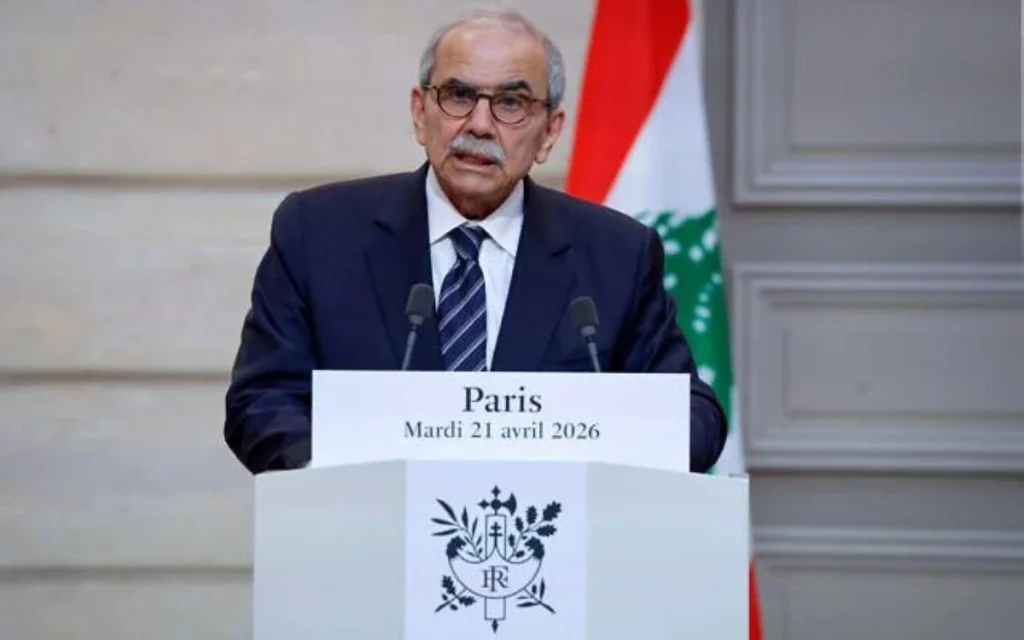
BEIRUT — Lebanese Prime Minister Nawaf Salam has denounced what he called a “dangerous and unprecedented” escalation in south Lebanon, as Israel carried out fresh airstrikes and issued evacuation warnings for more than a dozen locations.
In a televised address on Satuday, Salam urged an immediate halt to the fighting and insisted that a “scorched-earth policy and collective punishment” pursued by Benjamin Netanyahu will not ensure Israel’s security.
A day after the Israeli prime minister said his forces had advanced deeper into Lebanon, Salam accused Israel of “implementing a policy of total destruction of cities and towns” and of carrying out mass displacements, claiming Israeli forces fighting Hezbollah are trying to “uproot Lebanon’s memory and erase the people’s history.”
He added that his government will do all it can to achieve a ceasefire, an Israeli withdrawal from Lebanon and the return of displaced people to their homes.
However, Salam defended his government’s direct talks with Jerusalem, saying neotiations are the “least costly path” for Lebanon. He said the negotiations are not guaranteed to produce results and at the same time they don’t mean a surrender for Lebanon.
Military delegations from the two countries held security talks in Washington on Friday, with more US-brokered negotiations planned for Tuesday.
A truce to halt the fighting between Israel and Hezbollah officially took effect on April 17, but has never been observed. Both Israel and Hezbollah accuse each other of violating the ceasefire and justify their attacks by the other’s alleged breaches.
A US statement issued after Friday’s Israel-Lebanon talks made no mention of the truce, but said the “productive military-to-military discussions” would inform next week’s political meeting.
Lebanon’s state-run National News Agency (NNA) reported several Israeli attacks in the south on Saturday, and the Lebanese military said two of its soldiers “were seriously wounded … by a hostile Israeli drone” near the southern city of Nabatieh.
The Israeli military issued fresh evacuation warnings covering villages near Nabatieh and others in the east of the country.
Hezbollah said it launched multiple attacks targeting northern Israel on Saturday, and had also clashed with Israeli soldiers in southern Lebanon.
In a statement, the group said it was confronting Israeli forces around the outskirts of the towns of Zawtar al-Sharqiyah, Yohmor al-Shaqif and Dibbine, adding that the troops “had not yet succeeded in taking control of the towns”.
The Israeli military told AFP that more than 25 projectiles were launched from Lebanon toward Israel on Saturday, while air alert sirens sounded in the northern cities of Karmiel and Safed for the first time since the ceasefire, according to the army’s Home Front Command.
Public broadcaster KAN aired footage shared on social media showing rockets falling into the sea off Israel’s Nahariya, near the border, sending beachgoers fleeing.
Netanyahu announced on Friday that Israeli forces had advanced beyond the Litani River, which runs about 30km north of the Lebanon-Israel frontier, and were “hitting Hezbollah head on”.
The Lebanese health ministry says that Israeli attacks have killed more than 3,371 people since 2 March, when Hezbollah drew Lebanon into the Middle East war in support of its backer Iran.
Source: Saudi Gazette