


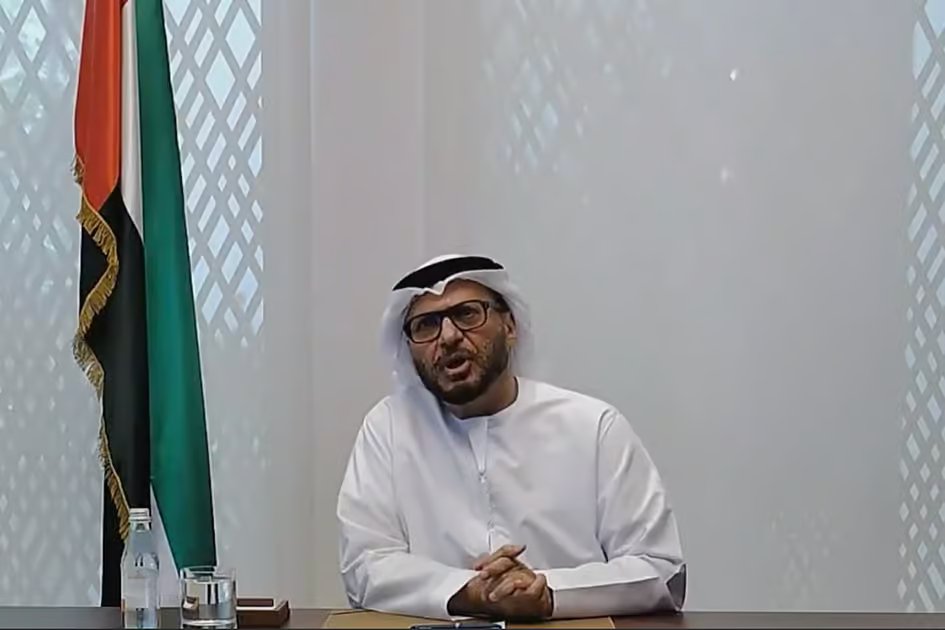
In an honest and detailed discussion, Dr Anwar Gargash, Diplomatic Advisor to the President of the United Arab Emirates, spoke candidly about the impact of the ongoing US-Iran war at the 18th edition of the World Policy Conference in Montreux, France.
The 30-minute session saw the UAE official delve into what he thought would happen in the long-term and even in the coming weeks.
Gargash, who has been vocal about the nation’s stance on this war since the conflict began, said he believes the issues that caused it have been “long delayed.”
Stay up to date with the latest news. Follow KT on WhatsApp Channels.
He added that the UAE has always insisted on diplomacy being the way forward. However, he then said, “I think our realisation that diplomacy had failed came forward when negotiations broke down in Geneva,” referring to the hours of talks mediated by Oman that ended on February 27.
Iran a ‘long-term’ threat to region
The official said the nation had observed that Iran’s initial strategy was to “enlarge the war, with very little consideration for its longer-term relations in the region.”
He emphasised that the UAE was attacked by “more missiles and drones than Israel.” This “conscious plan,” he said, will “affect Iran’s position and posture regionally”.
It has now become very clear to the region, to the United Arab Emirates and other countries, that Iran is the long-term threat.
Dr Anwar Gargash
A ‘tug of wills’
He described how both sides remain resolute, referencing how Iranian parliamentary speaker Mohammad Bagher Ghalibaf said in Persian that the “Americans are stronger” and have more resources and capabilities. Gargash explained that Ghalibaf made such a statement in an attempt to “coin the Iranian interpretation of victory in the regime still standing, not in the regime actually winning the confrontation.”
As he spoke of the standoff between the US and Iran, he said the Americans have found a “very, very effective” way of hurting Iran without going to war — through economic boycott. Iran, similarly, has found a way to cause harm by blockading the Strait of Hormuz and carrying out attacks on shipping.
In fact, on the date of publication, according to Iranian media, the IRGC Navy detained two vessels over alleged unauthorised passage and repeated navigation violations.
He said this conduct is causing other nations to view Iran as a “pariah state,” as they do not see the blockade as a legitimate form of self-defence.
This, he said, must bring the situation back either to the beginning of a political agreement or to a new confrontation.
Did the UAE have any indication of Iran’s response?
Perhaps the most surprising revelation of the discussion was that Emirati leadership had held successful meetings with Iranian leaders at multiple intervals before the war began.
Lana Nusseibeh, the UAE’s Minister of State, visited Tehran weeks before the war began — on February 10. She met with Iran’s Foreign Minister Abbas Araghchi during her official visit, where they discussed regional developments and security. Gargash said that Nusseibeh was “very satisfied” with their political considerations.
Gargash also mentioned a meeting between Sheikh Mohamed bin Zayed Al Nahyan, President of the UAE, and Iran’s late former security chief Ali Larijani.
Gargash said Sheikh Mohamed “described that meeting as his best meeting with an Iranian official in the last several decades.”
He said there was a great deal of “positive signalling” from Iran ahead of the war. This in turn indicated a dichotomy within the nation’s leadership, with some factions focused on economic growth and others “deciding war and peace.”
‘Disjointed, disunited’ leadership in Iran
On Thursday evening, multiple high-ranking Iranian officials took to X to emphasise that Iranian citizens are unified and are not “hardliners,” after US President Donald Trump posted on Truth Social that Iran was having a “very hard time” figuring out who its leader is.
Trump also claimed there was “crazy” infighting between “hardliners” and “moderates.”
The swift rebuttal of Trump’s statement, Gargash said, shows that “they look at that as a serious concern.” He added:”We are seeing a very disjointed, disunited Iranian leadership.”
Long-term impact on the region
The UAE official laid out several points he believed would define the region’s long-term trajectory.
He began by restating that Iran would be seen as the strategic threat — nations that attempted to maintain ties, commercial relations, or even had signed strategic agreements with Iran were targeted nonetheless.
Gargash also pushed back on prevailing opinions, saying he believes the US footprint in the region will grow more prominent, not less. This he elaborated involves equipment, alliances, training, and political and diplomatic engagement, not just physical bases.
He also foresees a decoupling between Gulf security concerns and those of other Arab countries, such as Syria, Lebanon, and Egypt. He said that while those countries continue to view Israel as a threat, and despite Gulf states’ continued solidarity with the Palestinian cause, many analysts do not perceive Israel as a threat.
He concluded by saying the world will witness a different version of the Islamic Republic — one defined not only by questions of regime survival, but of economic survival as well.
Source: Khaleej Times