


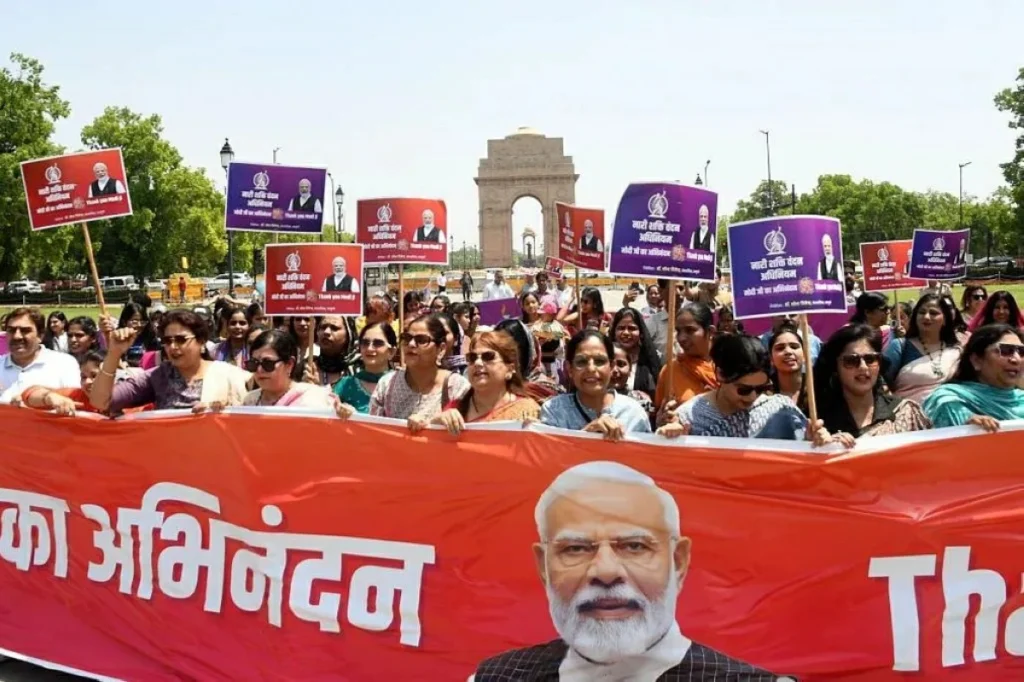
NEW DELHI — India is preparing for a redraw of its political map, driven by what the government says is a push to reserve one-third of seats for women in parliament and state assemblies.
Prime Minister Narendra Modi has framed the moment as historic, calling the proposed amendments “the fulfillment of an important responsibility towards the women of our country,” while urging parties to support the legislation in “one voice.”
Parliament begins a high-stakes debate on Thursday on bills that would activate women’s reservation and expand the Lok Sabha, the lower house of parliament, with the government seeking a quick passage the legislation during a three-day special sitting.
India already reserves 33% seats for women in village councils and municipal corporations in urban areas.
Women make up only about 14% of India’s 543 lower house MPs. The reform would raise that to roughly a third, closer to global norms. Its rollout is now tied to a population-based redraw of constituencies based on the 2011 census — likely expanding the lower house from 543 to about 850 seats.
But this has fueled controversy, with opposition parties accusing the government of rushing changes during an election season.
Opposition leaders argue that the women’s reservation bill is being used as a political cover for delimitation.
Congress Parliamentary Party leader Sonia Gandhi, writing in The Hindu on 13 April, said the government’s push was not really about women’s reservation but about delimitation, which she called “extremely dangerous” and “an assault on the Constitution itself.”
Her article turned what had been a procedural debate over implementation into a broader fight over federal balance, census timing and the rules for redrawing India’s electoral map.
She added that “delimitation, not women’s reservation, is the core issue,” underscoring concerns that the sequencing and data basis of the exercise could distort political representation.
Leader of the Opposition Rahul Gandhi has taken a sharper political line, accusing the government of using delimitation to rebalance power across regions and communities.
Gandhi characterized the proposal as an unfair appropriation, warning that it could disadvantage the country’s marginalized population such as the Dalits and Adivasis and as well as states with slower population growth.
Congress President Mallikarjun Kharge said, “We all are in favor of the Women’s Reservation Bill. But the way in which they have brought it, we have reservations about that,” calling the move “politically motivated.”
Regional parties, particularly in southern India, have been more explicit about the federal implications of the move.
So far, India has redrawn parliamentary seats three times based on the decennial census in 1951, 1961 and 1971. Since then, governments of all stripes paused the exercise, fearing an imbalance of representation due to varying fertility rates across states.
The Modi-led Bharatiya Janata Party (BJP) government has signaled a break from past caution, proposing a fresh delimitation based on the 2011 census.
That shift has alarmed opposition parties,especially in the south, who fear it could cost them seats and influence, effectively penalising regions with lower population growth and stronger economies.
Tamil Nadu chief minister M.K. Stalin has emerged as one of the most vocal critics, warning that delimitation based on population risks penalizing states that have achieved lower population growth through decades of social policy.
Stalin called the delimitation plan a “massive historic injustice,” with his ruling DMK party calling statewide black-flag protests on Thursday.
“Is punishment being meted out to Tamil Nadu and the southern states for the crime of striving for India’s growth?” he asked.
His position aligns with a wider southern concern that the exercise could shift parliamentary weight toward northern states.
In Telangana, opposition Bharat Rashtra Samiti party leader K.T. Rama Rao sharpened the same argument, warning against linking women’s reservation to delimitation and urging immediate implementation of quotas without redrawing constituencies.
The five southern states — Tamil Nadu, Andhra Pradesh, Karnataka, Kerala and Telangana — account for about 20% of India’s 1.4 billion people.
They also outperform the rest of the country in health, education and economic prospects. A child is less likely to be born here than in the north, due to lower population growth rates.
Their leaders are worried that the more prosperous south may lose parliamentary seats in the future, a “punishment” for having fewer children and generating more wealth.
Tamil Nadu, Kerala, Karnataka and Telangana had sought to extend the freeze on seat redistribution for 25 years.
The BJP government, for its part, has sought to counter the federal backlash with assurances that no state will lose representation in absolute terms.
While details remain fluid, the broad approach involves increasing seats across states, potentially on a pro-rata basis, rather than redistributing existing ones.
Union Home Minister Amit Shah has consistently defended the linkage between reservation and delimitation as a matter of administrative necessity. — Agencies
Source: Saudi Gazette