


[Editor’s Note: This article is part of Villages of the UAE, a Khaleej Times editorial series that looks beyond the country’s skylines to the quieter communities nestled in its mountains, deserts, wadis, and along its coast. Through the voices of residents and the rhythms of everyday life, the series explores how tradition, place, and people continue to shape the UAE’s social fabric.]
Along the shores of the Arabian Gulf, in the far north of Ras Al Khaimah, Khor Khuwair tells the story of a place shaped first by nature and necessity, and later by industry, transforming from a quiet coastal village into one of the emirate’s most important industrial hubs.
Nearly eight decades ago, the settlement was home to no more than a hundred people. Isolated and undeveloped, it stretched along the coastline where sea, desert, and mountains met.
Life was simple, but demanding. There were no salaries, no formal jobs, and no modern services. Families depended on fishing, date farming, and raising livestock, with daily survival tied closely to effort, season, and the tides.
Stay up to date with the latest news. Follow KT on WhatsApp Channels.
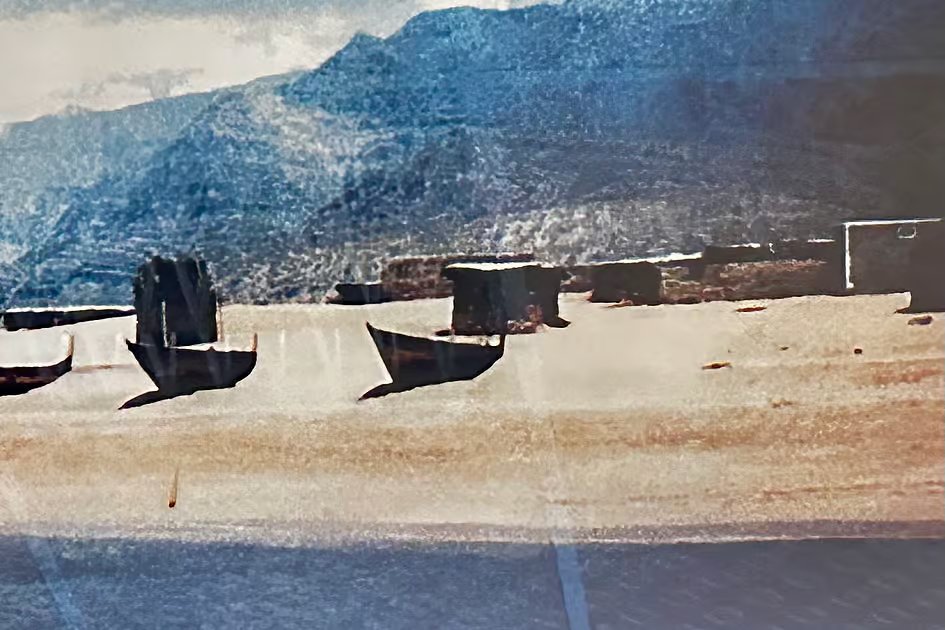
For longtime resident Khalfan Ali bin Hassoon Al Shehhi, now nearing 80, the memory of old Khor Khuwair remains vivid. He recalls a village without paved roads or transport, where movement itself required endurance. People travelled by wooden boats powered by sail, or by camels and donkeys across rough terrain. Journeys to other emirates, including Dubai and Sharjah, could take days, dictated by weather and wind.
This deep connection to the khor (bay) is reflected in moments such as one from 1982, when fishermen Saeed bin Salem Liuyoui and Mohammed Saeed Khanbeesh were seen catching a giant whale shark known in Arabic as Al Khar in its waters.
The extraordinary event drew widespread attention in Khor Khuwair, with residents gathering along the shoreline to witness a catch that stood out at the time.
Small boats from neighboring regions docked along its shores, quietly connecting the village to a wider network of coastal trade. In the absence of markets or shops, the khor functioned as a marketplace, workplace, and meeting point all at once.
Homes reflected the same simplicity. Built from stones carried down from nearby mountains and bound with mud, they were modest but functional. A single house often sheltered an entire family, with parents and children sharing one space and only the essentials for daily life. Resources were limited, but the sense of community was strong.
Seasonal rhythms shaped how people lived. During the intense summer heat, families built temporary shelters along the shore using palm fronds, taking advantage of the sea breeze for relief. In winter, they moved inland into sturdier homes made from palm trunks and mud, offering protection from colder winds. Life was not static; it constantly adapted to its environment.
Cooperation between communities was essential. People from coastal and mountainous areas exchanged goods, including fish for clay, eggs, palm products, and other necessities, creating a balanced system of survival.
Water and food were never taken for granted. Residents often travelled long distances, sometimes for weeks, to collect fresh water or harvest seasonal produce. Every resource carried value, and nothing was wasted.
By the 1960s, small signs of change began to appear. The arrival of cars introduced a new level of mobility, though infrastructure remained limited. The village gradually expanded from around twenty houses into several small neighbourhoods, known locally in Arabic as sha’biyaat, with families settling close to the khor.
By the 1970s, the population had grown, but daily life still revolved around fishing, farming, and trade through the inlet.
The most significant turning point came in the mid-1980s, when industry reached Khor Khuwair’s shores. What had long been an untouched landscape began to change with the establishment of early industrial facilities near the mountains.
Among them was a site known locally as ‘Romo’, which handled large industrial pipes transported by sea, likely linked to oil and infrastructure projects. Its presence marked a decisive shift from a purely traditional economy to one increasingly shaped by industrial activity.
This development laid the groundwork for Khor Khuwair’s transformation into a major industrial area. Over time, the natural inlet evolved into a formal port capable of receiving larger vessels, strengthening its role in regional trade. Factories and industrial operations expanded, redefining the coastline and creating new economic opportunities that replaced older, labour-intensive ways of life.
This development laid the groundwork for Khor Khuwair’s transformation into a major industrial area. Over time, the natural inlet evolved into a formal port capable of receiving larger vessels, strengthening its role in regional trade. Factories and industrial operations expanded, redefining the coastline and creating new economic opportunities that replaced older, labor-intensive ways of life.
Yet even as the landscape changed, the memory of the old village endures. For Al Shehhi and others who witnessed its earliest days, Khor Khuwair is more than an industrial zone; it is a place defined by resilience, cooperation, and a deep connection to the sea.
Al Shehhi reflects: “We are grateful for the life we have now, but the memory of old Khor Khuwair is still alive in the hearts of those who lived here. The khor was the heart of the village; everything about it reflected the life of the people of the sea, hard but full of simplicity, cooperation, and generosity.”
Today, Khor Khuwair stands at the intersection of past and present. Its factories, port, and vast limestone quarry operations, among the largest in the world, produce tens of millions of tonnes annually through companies such as Stevin Rock, reflecting decades of growth, according to the company’s website.
Its foundations remain rooted in the natural inlet that once sustained a small, determined community. In that contrast lies the essence of its story: a village shaped by hardship, transformed by industry, yet still anchored to the waters that first gave it life.
Source: Khaleej Times